Showing posts with label rolica. Show all posts

Sunday, January 29, 2012

Rolica - The First French Position - Act Two

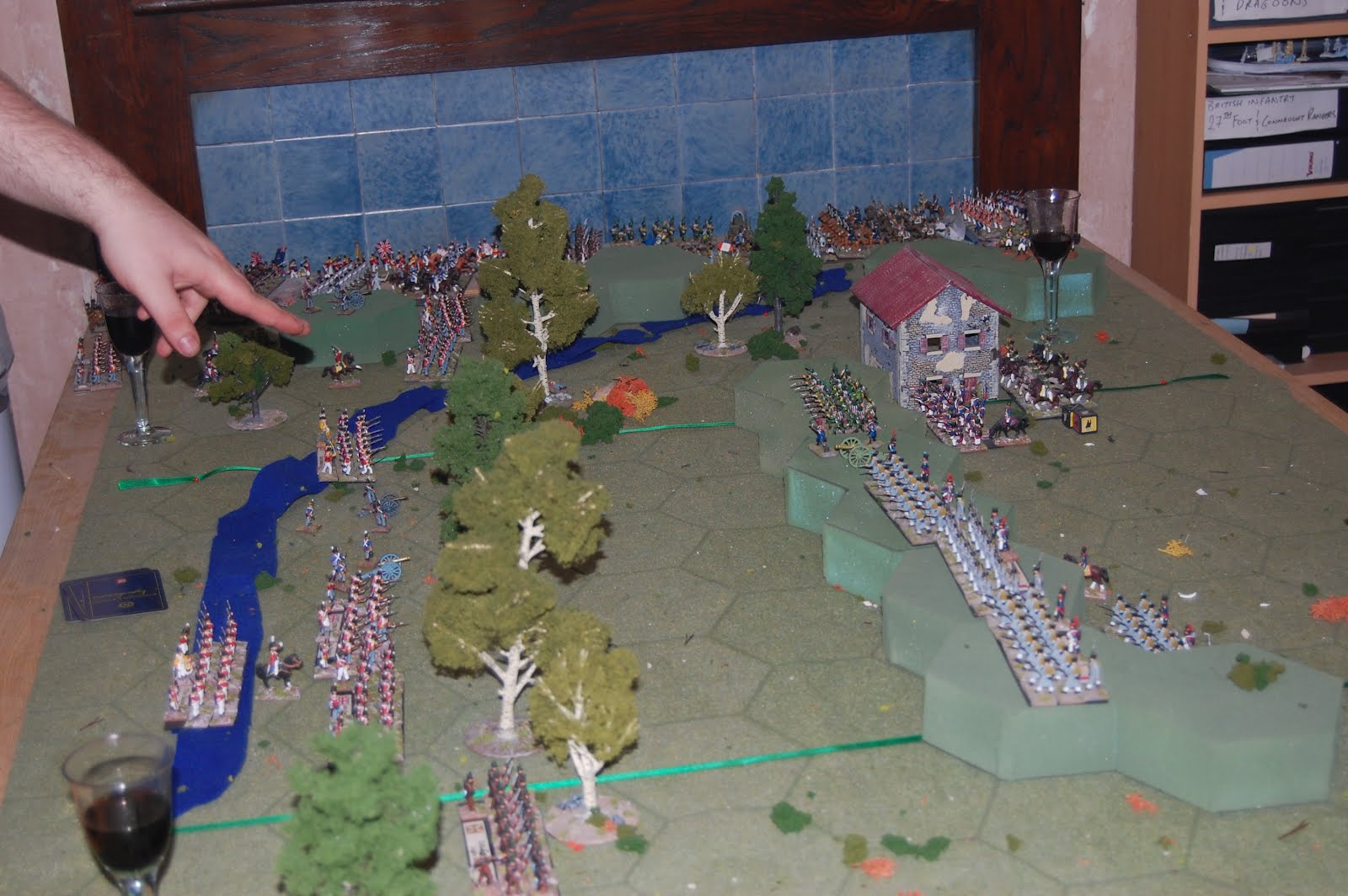
As the redcoats consolidate their position on the French right (just out of shot on the right), the 4th Dragoon Guards led by General Ferguson sweep into the rear of the French horse

As may recall, at the end of the first act, the French had lost an objective on their right to a bold move by British infantry, supported by a regiment of the 4th Dragoon Guards. This left them in dire straits as it meant that any attempt to withdraw in the face of the British advance would likely be cut off. The French generals decided to risk an attack on the left, hitting the point where the British line was held by Portuguese troops, rather than attempting to retake the objective in the hope of throwing the British plans into dissarray.


Meanwhile on the French left, French chasseurs hit General Trants Portuguese

This was a tense moment as the British were sitting on some good cards. If they surrendered the iniative by going into square and tying up part of their hand, there was a good chance that the their plans on the French right could grind to a halt. On the other hand, the French cavalry, tougher than their Allied counterparts were in a position to crush the vulnerable Portuguese. It didn't help matters that French infantry were moving up to support the cavalry charge and would riddle a square if one was formed.

In the end the Portuguese formed square and managed to drive off the French cavalry, but not without casualties themselves. Meanwhile, the French infantry got closer and closer...


There's good eating on that pony, Francois

On the French left things suddenly took a turn for the (even) worse as throwing caution to the wind, the 4th Dragoon Guards routed their foes completely with some rather special dice rolling.


Surprised? Moi?
(it is unclear whether General Von Casey is eating the horse shown in the previous picture, records from the period are sketchy at best)

This left the French reeling as it looked like the redcoats were going to sweep in from the left and roll up the whole position. The French were left with an even more unattractive proposition, they could push where they were winning, on their left or where they were losing, on their right. But they could not do both.


The 22ieme Ligne pull out of the line and turn to face the British onslaught

Eventually after some discussion they decided that something had to be done about the British cavalry on their right and they pulled the 22ieme ligne out of the line and sent them under one of General Delaborde's aides to drive off Les Roast Bifs.


How few remain...

The 22nd Ligne having moved out of the line, charged the 4th Dragoon Guards who fell back, but then ran into the guns of the Inniskillings who met them with a volley that tore the heart out of the regiment.


Archangel Michael protect us in battle...

The French attack on the left moved forward and bayonet charged Trants Portuguese while they were still in square. This left the Portuguese teetering on the edge of collapse, though they managed to hold on for another turn. The Cacadores in the woods began to look distinctly shifty as the French hammer blow descended.
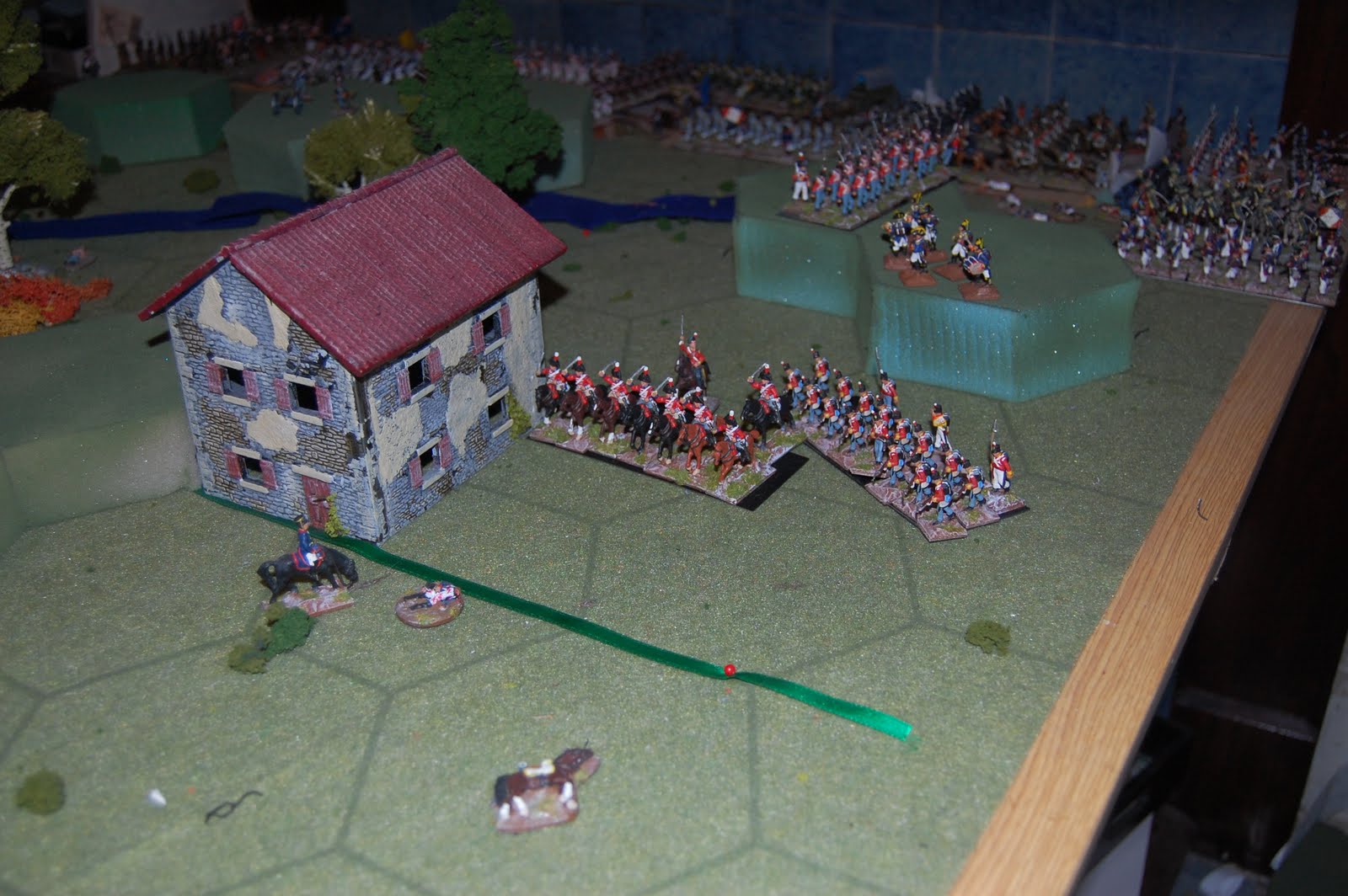

On the French right on the other hand, things were not looking so rosy

The 4th Dragoon Guards were poised to charge again, when a second roaring volley of French infantry symbols from the Inniskillings finished the 22ieme. General Delaborde's aide was lucky to escape with his life and was left with the uneviable decision of fleeing the field entirely or attempting to outrun an entire squadron of British cavalry.


Manuel? Manuel?
The Portuguese line begin to feel very lonely indeed...

If British dice were hot on the French right, the French dice were on fire on the right. A single volley from the 2nd battalion of the 62ieme Ligne wiped out the Cacadores to a man and only damnable luck on the part of the first battalion spared the 12th Line from complete destruction. However, it looked like this was about the change as the 2nd battalion swung around.

The Generals Von Casey paused for a moment to check a very important point...


Hmmm...I wonder if it fits?

It fits!

Please stay tuned for part three.

Thursday, January 26, 2012

Rolica - First Position

General Du Gormand fraternising with the enemy, as is his wont

A fortunate set of coincidences meant that the brothers Von Casey and General Du Gormand were available for a game last week. It was a short notice sort of affair and with that in mind, we played the first scenario from the Command & Colours: Napoleonics books, Rolica.
Rolica has a wonderful "world turned upside down" feeling about it. The stereotypical Peninsular battle involves the redcoats clinging to a hill while the French pelt them with columns, a caricature to be sure, but not unrepresentative. Rolica on the other hand, is a holding action on the part of the French General Delaborde. Wellesley has advanced on Lisbon and the French are desperately hoping the reinforcements will show up so that they may face the British with something like equal numbers.

With that in mind Delaborde picks a strong elevated position and decides to fight a delaying action. He holds the ridgeline until such time as he sees that his position has been outflanked and then retreats in good order to a second holding position. It's a curious thing, a battle (admittedly on the first half of a battle), where both sides achieved their objectives. Delaborde bought himself some time and kept his army together in the face of larger numbers. Wellesley faced the French for the first time that century and pushed them off their hill. He also didn't lose to an army that had a habit of victory in his first independent command against a European foe.
This is something I've noticed, particularly when writing Kriegspiels. In the absence of written game objectives, players can often be satisfied with what would seem to be quite ambiguous results. I've run games where both players achieved their stated objectives and because they didn't realise that the other fellow also believes that he's won, they can end the game feeling rather uppish.

But back to hard pounding.


The French army band, lacking the jingling Johnny.
(figures by Strelets, painting by Mark Bevis)

The scenario calls for two British objectives to be placed at the rear of the French position. This was an excellent opportunity to show off some of my French ephemera, like the Strelets army band displayed above. I really like these fellows, mainly because I love brass bands and I recall what a treat it was to have the Garda band playing at our graduation. Anyone who has ever doubted what the fife and drums were for should see the electricity that ripples through a body of men when marching to music.


The Brothers Von Casey in dastardly consort.
Never has William looked more like a man of destiny

General Du Gormand and I retired to the front room, leaving the Brothers Von Casey in possession of the field for the planning stage of the battle. Our initial hand of cards was a very strong one, including a card called "Le Grande Manoeuvres". This allowed us to move four units a distance of four hexes. Powerful, but it would leave them open to an immediate counterattack as being fagged out from their exertions that wouldn't be able to battle. Our plan was to use this card to advance on the left to threaten the undefended French objective and force the Frenchers to weaken their line.


French foragers at the rear of their position, no doubt laden with the loot of plundered homes and churches - in this instance marking a second objective
(figures by Strelets, Irregular and Uwe Wilde, painting by Mark Bevis)

One of the disadvantages of the French army in Portugal was its weakness for looting. A major sore point of the Convention of Cintra, the rather shameful treaty signed shortly after Rolica (though there were several battles to go), was the French were allowed leave with their property, including the loot which they'd taken from the Portuguese. I ran a very successful Kreigspiel a few years ago about a group of British junior officers escorting a convoy of French wagons to a port to be sent to France.


General Du Gormand moves the British left

It helped somewhat that due to poor operational security on the part of the French, we knew that they felt that their right flank (marked by the band at the rear of the house) was safe as we would be unable to threaten it for several turns. How wrong they were...


The British centre-left advances while the French warm their guns
(pipe by Petersons of Dublin, cigars by Jose L Piedra of Cuba)

The bold move on our left continued, while the French pummelled our centre with long range artillery fire. This move did not have the effects they were hoping for and led to a rethink. In the foreground, you can see the speakers which were providing musical accompaniment, a selection of marches by the band of the French Foreign Legion and the band of the Coldstream Guards.


As redcoats begin to threaten their left, the French players grow pensive and begin to rethink
As the British flanking maneuvre began to develop, the French realised that their right flank was hanging badly in the air. The choice had to be made to attempt to shore up their right or to launch a spoiling attack somewhere else?

As the redcoats close in the French band suddenly
remember how to play "The British Grenadiers"


The French horse advance on the right
and it all looks a bit grim for our Portuguese brethren

But faint heart never won fair lady and the French launch a counterattack that could turn the tide of battle. Two battalions of French line move forward, supported by a squadron of Chasseurs a Cheval to threaten the British right, held by the undoubtedly brave, but somewhat inexperienced Portuguese troops. The Portuguese colonel is in two minds, to receive the charge in square, whereupon he will be slaughtered by musketry from the French foot or to try and stick it out in line and be ridden down.

A hard choice.

To be continued...

Saturday, November 19, 2011

Command & Colours Napoleonics: Rolica 17th August


Gorman helping in his own inimitable way. We discovered that we were short a few impassable hills just after laying out the field, so I rambled outside with some foam, quickly did the business and we were back in action within munutes, the scent of spray paint assailing our nostrils.


General Du Gormand glass of Argintinean plonk close to hand surveys the battlefield.

For those of you unfamiliar with the battle of Rolica, I shall summarise. Both Spain and Portugal had risen against the French invader and he was having a hot time of it. The British had landed in Portugal at a spot called Mondego Bay. They were led by Wellington or plain old Wellesley as he was at the time and began to march on Lisbon, pursuing a French force under Delaborde.

Wellesley was very keen to get weaving because he was due to be replaced by more senior officers being sent from England. Delaborde took up a strong position by the village of Rolica and was booted off it on the morning of the 17th of August. He fell back in good order and took up a second position, again on a ridge line, but one that could only be approached by several steep ravines.

So there you have it; an almost complete reversal of the traditional Peninsular battle. The outnumbered French sitting on a hill while the British come for them with the bayonet.


One of the ravines, the British infantry have to advance on a narrow frontage towards the enemy position. The hills marked with stones are impassable.
The view from the French lines. Gorman held is cavalry reserve back until late in the battle and punished my Portuguese troops with them. Note the use of foam offcuts to mark impassable hills. I must come up with a more elegant solution.
The advance continues. The French ration their cards while I spend mine trying to advance of a broad front. Getting the guns forward proves almost impossible.
Cat stops play. Sissi surveys the advancing redcoats. Despite her Austrian background, I can't help but thing she is rooting for the French.
Sissi lines up a shot. Traditionally French general acoutre their female "ADC"s in hussar uniforms. General Du Gormand falls down on the job again.
You there! Dress that line!

Sergeant, take that man's name!

And that's quite enough of that.

As my forces inch forward, Du Gorman continues to pummel me with gunfire chipping away at my infantry.
The guns in question. The British infantry start to close on the French position, bloodied, but unbowed. The French infantry are still fresh though.


Finally, the redcoats close the distance after a great deal of punishment. But will they have sufficient strength to take the position?

Even as I ponder this the French left begins their counter-attack.
Musketry crashes up and down the line. Some Frenchmen fall and the issue hangs in the balance.

With the infantry fight in the centre still in doubt, the French cavalry begins to move forward ready to take the centre column in the flank before the troops on the right can come up.
Frenchmen are falling fast in the centre, but will it be enough?
As the Kings Royal Halberdiers arrive at the mouth of the ravine, they are greeted by the sight of bodies everywhere.

The counter-attack develops completely now, the French line smashing the heads of the British columns.
And it's all over., With the centre column destroyed, the French advance to contest the mouths of both ravines and their cavalry (off camera) pick off a Portuguese regiment to take the game 6-5. Close, but no cigar.

This was a good game and the second of two Rolica scenarios we played. General Du Gormand (his choice of female companion not withstanding) was a canny opponent, who played his hand well and made careful use of his artillery to weaken units for infantry counterattacks. His use of the cavalry at the end of the battle was devastating.

In retrospect, I think I tried to advance on too broad a front and I should have been willing to endure a certain amount of waiting to get my guns up. I relied too much on Gough style Tipperary tactics.

Revanche!