Thursday, February 11, 2010

An inconvenience rightly considered.

Sir Fitzroy MacLean, Gentleman Adventurer


Eastern Approaches is autobiography of the best sort. A tale of high adventure that begins in Paris in the Thirties and ends in Yugoslavia at the end of the Second World War it is broken into three sections.

The first begins in Paris, where Foreign Office man about town, Fitzroy MacLean tires of the diplomatic round and request a posting the Soviet Union. He arrives in Moscow to see the Stalin's society before and during the great purges. Not satisfied with a ringside seat at a witch hunt, he spends his holidays travelling in the near East, dodging NKVD minders and Intourist officials to see Samarkhand and Kabul.

The second section concerns his time in the Western Desert with the SAS. Their operations end in a mixture of farce and failure, but are redeemed in the last chapter by the piratical kidnapping of a Persian general.

The last and longest section is about MacLean's time in Yugoslavia. MacLean was chosen to head a fact finding mission to Yugoslavia as there were two resistance movements, the Chetniks and the Partisans. The British were already committed to the Chetniks, but there were concerns that they were spending more time fighting the Partisans than the Germans. MacLean's job was to find out who was killing the most Germans and throw British support behind them.

This section is a fascinating melange of high level politics, boys own adventure and brutal endurance. The portraits of Churchill and Tito are particularly interesting, adding a human dimension to the grand strategy.

More honourable than Flashman, more human than Bond and funnier than Hannay, MacLean is well worth a read for those who like their escapism to combine all the virtues of fiction and fact.

Highlanders & Playing by Email


93rd Highlanders prepare to receive a French charge
(Sir Donogh McCarthy RA)
There's been very little going on here at Chez Kinch other than course work and study, though the end is very much in sight.

Above you can see some of the fruits of last years painting, these are Crimean Highlanders from Strelets range. I liked them so much that I decided to use them in my Napoleonic army and the anti-bread faction could go hang. Painted by the stalwart Mark Bevis, these gallant Highlanders received a charge of French cuirassiers in line, a thin red streak tipped with steel if you will.

Sadly, their stand did not go as well as their counterparts in Robert Gibbs famous paintings and they were ridden down like dogs after being wracked with shot and shell.

The hill behind our Scottish friends is made of two inch upholsterers foam, cut with a kitchen knife and sprayed green. I used Army Painter Green Primer. The whole construction took about half an hour to make three hills from start to finish. They're light, durable and don't need looking after.

A picture tutorial might be forthcoming, though to be honest the process is about as taxing as a three piece jigsaw puzzle.

Most of my figures are packed away at present, though I managed to get a little gaming into my life between course work and baton training. I'm running a play by email Kriegspiel game of the Waterloo campaign, which is proving very interesting. We're getting through about one turn a week, though some players require more chivying than others. I'm enjoying the game greatly
and I am considering running a larger version, with more players and smaller forces when this one is finished. The idea being that smaller forces mean that players have fewer things to worry about while more players allows you to create a chain of command, which offers greater opportunities for roleplaying.

More players does mean more players to chivy though...

...that said, given that shift work will be my lot for the forseeable future, a game that doesn't require all the players to be on the same schedule, while still scratching that wargaming itch might be no bad thing.


Sunday, January 17, 2010

I'm not really playing a game...

The Land of Counterpane by Jessie Wilcox Smith
(from a poem by Robert Louis Stevenson)

...I'm running a simulation.

I am always suspicious of players who claim that wargames, particularly toy soldier wargames, are simulations. Maybe I'm overly conscientious but it always seems to me to be trying to add a spurious legitimacy to something that is just shockingly good fun.

Its rather like trying to tell your father that you're not really going to a rock concert to enjoy yourself, but rather to learn something very important for your upcoming music exam. Or convincing yourself that chocolate is a special kind of brain food and that you're eating it out of duty.

That's not to say that you can not simulate aspects of conflict in a wargame and they can certainly help you think about certain areas of interest (logistics, small units tactics, reconnaissance, etc) in new ways, but I don't think that wargaming (except in a few very specific cases) can offer you any answers.

But it can help you think of more interesting questions.

And its fun.

Which is justification enough in my book. Work hard by all means, but do not attempt to make your play work or your work play as neither will benefit by the exchange.

As so often happens on the Internet, the person who sparked this spot of thinking aloud will like as not never read it, but I'm glad that despite the fact that we will never reach an agreement, he forced me to consider and clarify my own position.

I think Paddy Griffith said it best, in his "Napoleonic Wargaming for Fun" (1980)

"One final word is called for, about the spirit in which wargames should be played. They are not mathematical exercises in which the players sit silently confronting each other, with their brains ticking over like miniature computers. Instead, they are social events; rather similar to dinner parties. The guest list should be given a little thought in advance, so that all the players will fit into that particular game and enjoy it. The bill of fare should be designed to suit them; and care should be taken to ensure that no one is left out in the cold. Even the most perfect set of rules (if such a miracle could ever be devised) is useless if it is used on the wrong occasion or with the wrong trimmings; so it is worth while tailoring each game to its social setting. If this is done thoughtfully and well, the result should be amusing, interesting, and successful evening's entertainment for all concerned."

A good wargame is first and foremost a social occasion, done for the pleasure of the thing; to see toy soldiers shining in their glittering rows, to eat and drink and gossip with good friends, to argue about history and rules and why this should and that shouldn't and Lasalle would never have done that you know. To be at play.


Sunday, January 10, 2010

Back to school.

Listed for the Connaught Rangers by Lady Butler


I am back at College after the work experience phase of my training. It's certainly been an experience that has radically changed my way of looking at things. One of the sadnesses has been how little gaming I've had time for. I enjoy gaming on many levels, but mainly as a means of meeting my friends and there hasn't been enough of that of late.

I got a little gaming in at Gaelcon in October and a single days worth of Memoir '44 over Christmas, but other than that it's been pretty slim. I intend to organise another outing soon.

In my off duty hours, I've managed to accumulate quite a force of Napoleonics mostly due to the painting skills of Mark Bevis of Micromark, whose affordable rates have made it possible to bulk out my Napoleonic forces without breaking the bank. I came to the conclusion that while I had had precious little money, I certainly wasn't going to spend it on figures that I wasn't going to be able to paint or play with. I'm too much of an egomanic to buy figures from Ebay which (quelle horreur!) might be based in a way displeasing to the might Kinch. Mark on the other hand is perfectly willing to accept figures already based and uncoated and has been very quick with emails and photographs to keep me updated.

I hope that the fruits of his labour will be gracing this blog in the not too distant future.

Wednesday, May 20, 2009


A mule by Frederic Remington.

In the run up to the exams, even the tiny amount of wargaming related stuff that I have been doing of late has had to go by the board. But I took delivery yesterday of a small package from Irregular miniatures yesterday that cheered me up in immensely. According to Charge! an infantry battalion should be accompanied by at least two baggage animals and a vivandiere. I have gathered together quite a collection of camp followers, but I needed some more baggage animals and Ian Kay of Irregular Miniatures was able to provide.

I have no camera with me, otherwise I'd post a proper picture, but the figures themselves are very nice, well proportioned, relatively clean of flash and a varied enough to be interesting without being so differant as to be difficult to paint. I've always used Irregular 6mm and 2mm figures before and found them very good and this standard has been maintained in their 20mm range. I also picked up from dead/wounded British soldiers for use with En Avant! and while such figures are never going to inspire fondness, they look well for what they are and will do the job.

Baggage for the artillery will obviously consist of caissons and such, though I'm a little lost as to what cavalry baggage would consist of.

More to follow exams permitting.

Sunday, May 17, 2009

"There's obviously no piss for the wicked"


Officer Crabtree* (played by the magnificent Arthur Bostrum), that I might someday aspire to such heights of professionalism and linguistic ability.


The last few months have been overwhelming and as the end of my phase one training comes into sight, I can look back on the first period of nearly four months where I have done absolutely no gaming whatsoever. My painting output has been diabolical; exactly three Riflemen since I joined the service. This is not for any lack of interest or desire on my part, but because of a simple lack of time. My new home is one that takes the idea of continuous assessment very seriously and my weekends pretty much belong to Mrs. Kinch, so there has been precious little spare time for other pursuits.


That said I've found the training a very positive experience, I hope (fingers crossed) to pass out of phase one and onto phase two soon, without having to repeat any exams or any such nonsense. Mrs. Kinch and I will be visiting Hanover towards the end of June during my two weeks leave.


That's not to say that there hasn't been any advances made on the wargaming front. I have started using a painting service and as a result I am on the way to completing my medium term wargaming goal for this year. I had hoped to assemble two small armies for Charge! It looks like this shouldn't be a problem as despite my (very) limited at funds at present, channeling the money I usually spend on figures into painting means that I should have both armies finished within a month or two.


Of course, the plan has changed slightly since I wrote it.


The original plan was to assemble a reinforced brigade force, consisting of....


General & Two Aide De Camp


Two Battalions of Foot

One Battalion of Light Foot

One Regiment of Horse

Two guns.

One caisson


The idea was that this force could be used for Charge!, broken down to its component companies to be used with Richard Borg's forthcoming Command & Colours Napoleonics and for my own Peninsula roleplaying game, "The Halberdiers".


The new plan is for a slightly adapted order of battle, so that the troops mustered can also be used with Jim Wallman's "En Avant" ruleset, a very simple set of rules designed to teach Napoleonic tactics to the general public at the National Army Museum. I've played "En Avant" several times and enjoyed it greatly, which means in classical wargamer style, I want to destroy it and remake it in my own image.


The new order of battle is as follows.


General & Two Aides De Camp

Three Battalions of Foot (one of which may be light, but will be of the same strength as a regular battalion)
One Regiment of Horse
Two guns & Teams to draw them.

Baggage to the scale of two baggage animals and two camp followers or one wagon per regiment.


The current rate of progress is as follows.


General & Two Aides De Camp - French complete, British two thirds complete.


One Regiment of Horse - French complete (barring basing), British a work in progress.


Three Battalions of Foot - One French battalion complete, two others two third finished.

British, one battalion complete, two others works in progress.


Two guns & Teams to draw them. - British complete barring one team, French guns complete, but no caisson or teams.


Baggage - Two wagons and four baggage animals done. Camp followers a work in progress. I've been looking at some very pretty Fine Scale Factory Vivandieres for these, though I think it would be best to paint what I have first before investing further.

Beyond writing a review of Paddy Griffith's "Napoleonic Wargaming for Fun" which I haven't managed to finish yet** (sorry John!), that's been it for the present.

My serious exams (legal & policing, etc) are coming up over the next ten days, so I don't expect to be able to post much for a while. But I thought a short post might be in order, just to fly the flag.

Your obedient servant, etc.

Conrad Kinch


*For those of you not familiar with this paragon of the policeman's art, I would suggest hunting up a copy of "'Allo 'Allo: The War Diaries of Renee Artois".

**I'll sav you the trouble of reading it; buy this book, it's superb. http://www.johncurryevents.co.uk/

Sunday, February 8, 2009

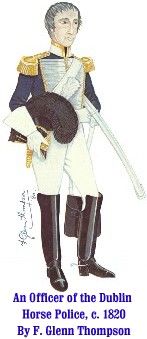
Dublin Horse Police

Thanks to the wonders of this fascinating modern age in which we live, I'm writing this on my shiny new laptop on the train back to college. The first week went well and if I had any doubts about this being the profession for me, they've been dispelled. The academic course is rigorous and the physical jerks are a bit daunting, particularly is you're as sedentary a chap as I, but I'm looking forward to the challenges.

The college was originally a barracks built in the early 19th century to quell domestic unrest and resist the French in case of another invasion attempt. A great deal of work has been done since then of course, but you can still see the basic structure of the barracks concealed under modern glass and paint. There's a reassuring quality to that, at least for me, a sense of a continuity. I think I've managed to work out, while strolling between the canteen and gym, where the old cavalry lines were. There are phantoms of Kipling's army here, the long past scent of blackball and wet serge and the acrid tang of horse piss.

I was also surprised to learn during a lecture on policing in Ireland that the first uniformed police force in these islands* was the Dublin Horse Police, who were founded in 1786 in order to quell riotous behaviour and general mayhem. I had alway assumed that the Met was the eldest police force, but it seems I was wrong.

There's been precious little wargaming activity these last few days. To be honest our feet didn't hit the ground during the first week, but I did bring down a small selection of figures and a travelling paint set.

Thus far I've painted three horses, which will eventually mount French Dragoons.

One idea I did have was for our upcoming large scale Little Wars game at Leprecon on the 28th of February. We bought approximately 640 Accurate British Infantry of the America War of Independancw, in amongst these were a great number of Sergeants carrying spontoons, rather more than really seemed necessary.

So to do something unusual with these figures, to celebrate my new profesion and to draw attention to Little Wars prisoner rules. I have come up with the following Little Wars house rule. It is totally unplaytested and will be of use only in the largest of games.

New Troop Type: Military Police

The Military Police come in two varieties, Horse Police and Foot Police.

The number of Military Police is determined by the scenario, but a player may not field more than one for every eighty men. If you are using the points system laid out in Little Wars, a Horse Police costs twice as much as a regular cavalryman, while a Foot Police costs twice as much as a regular foot soldier.

Horse Police are mounted and count as cavalry in every way. Foot Police count as foot soldiers.

The following exceptions apply:

A single Horse Police figure may take control of any prisoners within 12 inches, relieving his comrades of the burden of escorting them to the rear. A single Horse Police figure may excort up to twenty prisoners without assistance.

A Foot Police may similarly take control of any group of prisoners within six inches, relieving his comrades of the burden of escorting them to the rear. He may control up to twenty prisoners without assistance and may also declare one building per game to be a POW cage.

Once a building is declared a POW cage, the Foot Police figure must be placed outside it and may not abandon his post until the game is over. A POW cage may hold as many prisoners as the building itself may physically fit, so long as the men are standing with the entirity of their bases flat on the ground or thirty, which ever is the larger number.

Men that end the game in a POW cage are counted as having been escorted from the field.


*Trying to find a politically neutral term for "The British Isles" is something of a chore, "These islands" is the best I've managed so far. "Britain, Scotland, Wales and Cornwall" is clunky and "The North Atlantic Archipeligo" doesn't exactly trip off the tongue.