Saturday, August 18, 2012

Combat at Aire - Part Two


Portuguese dragoons closing in on the embattled centre

To recap -  the Allied army under Wellington has pushed the French out of Spain. Marshall Soult has left a rearguard under Clausel to buy time for the evacuation of stores at Aire. The battle began with the allies crossing a fordable river to assault a French held ridge. The Portuguese infantry took the lead and smashed the French centre, which was looking very dicey until Savage stabilised the situation with his cavalry.


The Portuguese dragoons clatter through the smoke, crashing into the French chasseurs


...but they hesitate at the last moment (roll badly), laying themselves open to a counter charge (battle back) by the French cavalry. 

The French cavalry charge immediately on Savage's turn and leave the Portuguese teetering on the verge of destruction. This was quite an interesting exchange as both players became quite fixated on it, using Scout cards to keep both units in play and try and build a hand for the next push.


But the Portuguese have a sting in the tail and down General Harispe. 

It seems the poor chap will not live to rally to Bonaparte in 1815 after all. I notice in this picture that my modular river, while very modular and river like is not looking it's best, mainly because it keeps moving around. Perhaps if I attached felt to the bottom perhaps?


But vengence is swift...

...and terrible.


Reduced to half strength, the Chasseurs had better turn back and look to their rear.


In the meantime, the Dragoons have come back over the bridge to support the Neapolitans.


But a second squadron of the 7th Portuguese come across the bridge to dispute matters


The 17th French Dragoons take the Portuguese in the flank, while a confused battle rages amongst the squares and the Neapolitans in the centre

This was quite a tough battle in some ways as the Portuguese are not the best troops and they were caught in square. However, the Neapolitans are very, very bad and needed to hit the Portuguese while they were in square if they were to stand any chance of victory. Savage was getting desperate for cards to bring his infantry back into the line. 


And the Portuguese promptly scamper back over the bridge followed by the 17th


The 17th then "threes about" and head back to the centre, where it is getting very confusing


But General Du Gourmand has finally managed to get his British infantry moving - and they start to cross the river.

This was a key moment, General Du Gourmand had been trying to get his British troops moving and they were having none of it for the most part. They were quite content to fight the battle to the last Portuguese. Savage  had some good troops and could certainly dispute their crossing of the river. The problem was that if he was going to win - it would be in the centre. He would need to be either lucky or pray for sluggishness on Du Gourmand's part because he wouldn't be able to be in two places at once.
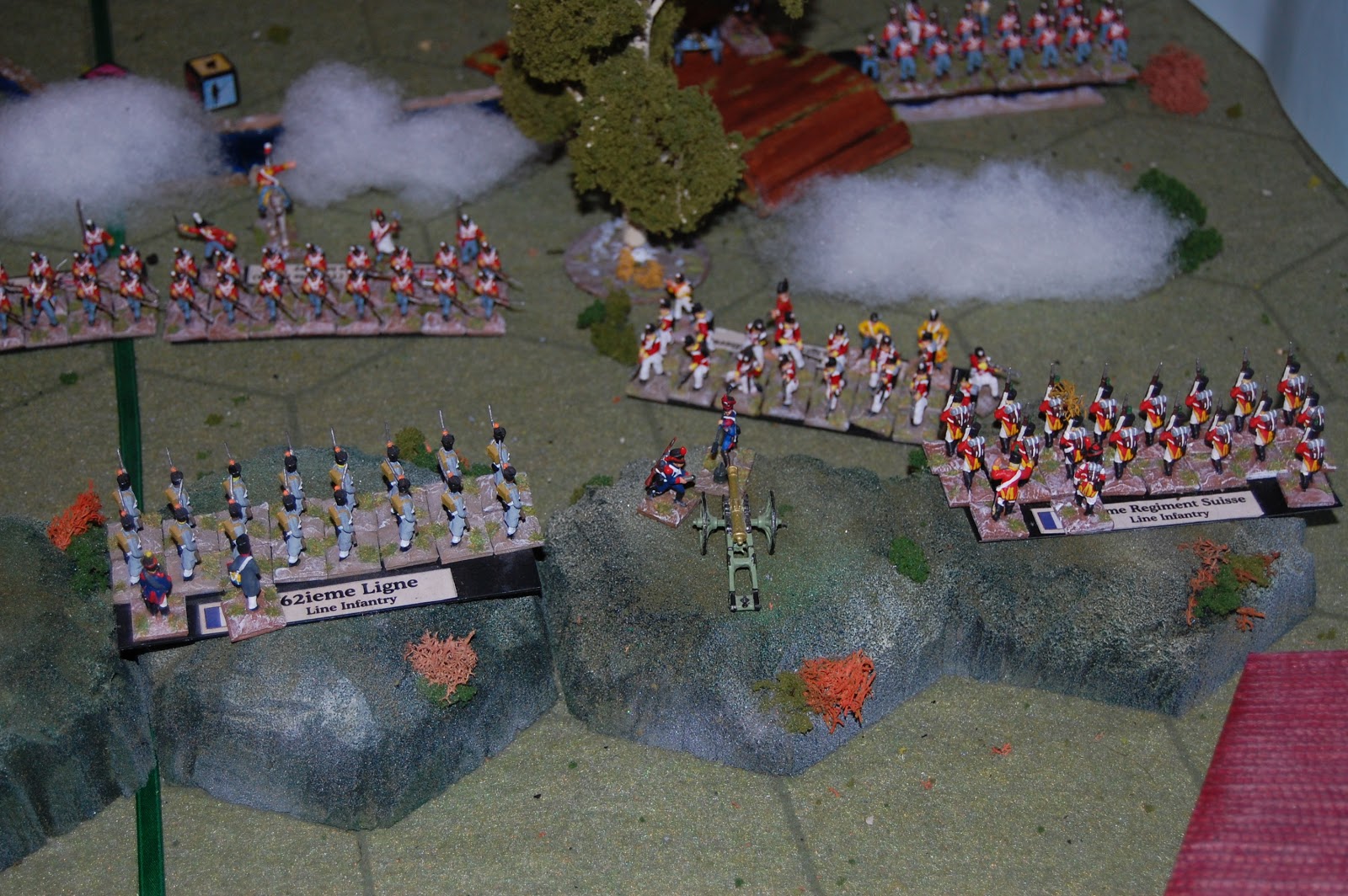

Savage prepares to recieve them.


The Kings Royal Halberdiers close in...


...and its all over. 

Sadly for Savage who put up a good show, one treads a narrow margin if one is hoping for Du Gourmand to make mistakes. Savage had done well, coming back from one point to four in the early stages of the battle. The result was five - six at the end, Du Gourmand knowing that pussyfooting about would do him no good and went straight for the jugular. 

A good game and definately one of the best scenarios in the Peninsular collection.

Friday, August 17, 2012

Command & Colours Napoleonics - Russian Expansion

The Campaign of France by Meissonier 
Not from the Russian campaign I know - but seems suitably bleak to me


I've been giving some thought to the Russian expansion for Command & Colours Napoleonics, which is something considering that we have only played a few of the Spanish scenarios and I haven't even finished the Waterloo collection yet.


The release date for the expansion has gone back to December from November, so General Du Gourmand has already started muttering about "...further delays and another spoiled Christmas..". I have faith however.

Actual picture of General Du Gourmand circa Christmas 2011

However, Tony Curtis at GMT very generously let me know what the counter mix will be for the new set. You'll find it below - along with some notes on what suitable 1/72 scale figures are available.


These chaps will be covering a multitude of sins


Line Infantry 9 units 3 blocks each

I was quite surprised that see that the Russian infantry are a quarter the numbers of regular infantry, but the proof of the game is in the playing. I reckon I should be able to put together two units from the Hinton Hunt Russian infantry courtesy of Old John.

Zvesda, who are without doubt the Rolls Royce of the plastic soldier world, have some wonderful plastic sets for the period, mostly based around the 1812 campaign. Their Russian Heavy Infantry Grenadiers can be used as line, if you snip the plumes off. 


Light Infantry 6 units 3 blocks each 

I reckon I can squeeze two units out of my Hinton Hunt Russian jagers, I'm at a loss as to where my other fellows will come from. Old John has made some very interesting suggestions - but it's all rather castles in the sky until I get the Spanish project finished off. 


Italeri Grenadiers - to be honest I don't see myself using them much


Grenadier 4 units 4 blocks each

I can cover one unit with the Hinton Hunt mitre cap wearing grenadiers, but I'll need a few more to finish the unit. Also, an entire division of Pavlovsky Grenadiers might begin to pall after a little while.

Italeri do a few Russian grenadiers with mitre caps, but they just won't go with the Hinton Hunts.

Zvesda's Heavy Infantry will be doing duty for the other three units, with their plumes gloriously unsnipped. 


Light Guard Infantry 2 units 4 blocks each

I have actually no idea what I'll be using for these chaps as this is one of those annoying periods where I know rather more about the actual campaign then about the uniforms.  Off to the Osprey I think. 


Guard Grenadier Infantry 2 units 4 blocks each

This is another instance of my eyes outstripping my knowledge. Back to the books Kinch.


HAT Russian Militia - how can you not use beard acting like that?


Militia 2 units 4 blocks each - HAT Russian Militia are a very creditable set, though I may try to pick the units up from Simon at Painted Napoleonic Armies rather than buying another large HAT set, half of whom don't get used. It may be shutting the stable door well after the horse has bolted to start considering it a sin of gluttony now, but how and ever...


Zvesda Hussars - I just love these figures, they are incomparable.

Light Cavalry 3 units 4 blocks each - Zvesda Hussars are the only choice for this. I've actually been using Russian hussars in my French army for several years. I bought several boxes of these when they first came out after reading the review on Plastic Soldier Review. They are wonderful, wonderful figures, full of dash and Napoleonic swagger. I still have some left over, so the decision is already made.


Strelets Dragoons - homely fellows, but serviceable.


Heavy Cavalry 2 units 4 blocks each - Strelets make Dragoons, but they're quite lumpen next to the Zvesda figures. Johnny has suggested a number of alternatives from SHQ/Kennington to Newline. I'll obviously be trying to keep costs down, but I think that I'd save for figures I like then make do with figures that I merely tolerate.

Zvesda Russian Cuirassiers

Cuirassier Heavy Cavalry 2 units 4 blocks each 

These are one of the few Zvesda releases that I haven't seen in the flesh. Looking at them on Plastic Soldier Review, they are perhaps not quite as nice as the Hussars, but cuirassiers are such plodding creatures compared to the dashing Hussar that it'd probably forgiveable. 


Zvesda Guard Cossacks

Light Guard Cavalry 1 unit 4 blocks 

These are to honest, the ugly ducklings of Zvesda's Russian output, but they are still quite fine by normal standards. However, they are Guard Cossacks and therefore are quite tame and staid characters. Not the sort of chaps the Zaporozhian host would have writing letters for them. 

Guard Heavy Cavalry 1 unit 6 blocks

I imagine a paint conversion of the Zvesda Cuirassiers will do the trick - but to be honest, I know precious little about the Russian Guards. 


These chaps have the right sort of penmanship for Sultan Mehmet IV


Cossack Militia Cavalry 3 units 2 blocks each

I'm in the habit of using Crimean War figures for Napoleonics and probably will continue to do so. I have a box of these fellows and while they have Strelets usual chunky sculpting, they are also dynamic and shabby and full of piratical style.  Not the sort of chaps one would care to meet down a dark alley, but certainly worth admiring from afar.  

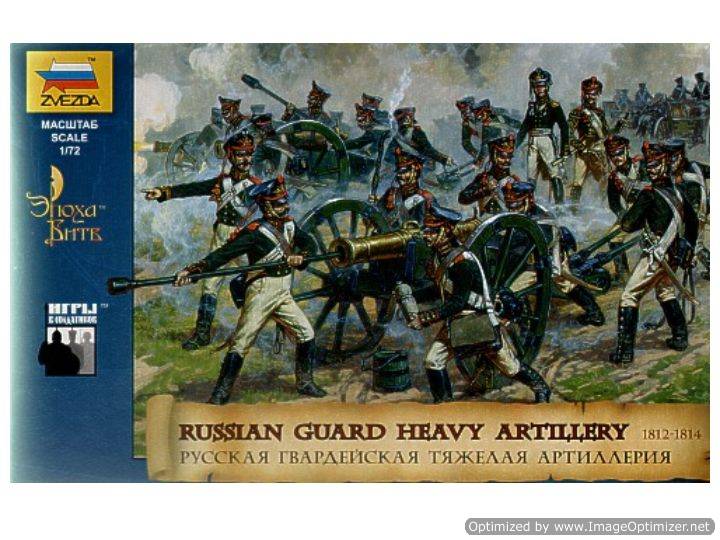
Zvesda Guard Heavy Artillery

Foot Artillery 4 units 3 blocks each

Horse Artillery 1 unit 3 blocks each

Guard Foot Artillery 1 unit 3 blocks  each

It simply wouldn't be fair to saddle the land that gave use Tchaikovsky with substandard artillery and Zvesda have done themselves proud. This is a particularly nice set and will do with minor adjustments for Line and Guard Foot Artillery. Damned if I know what I shall do for Horse Artillery though.  

Italeri General Staff

Leader 4 blocks

I actually have a copy of this set and it's not bad - I have to be fair cannibalised most of the Russian generals at this point for conversions or to represent French generals wearing particularly large hats, but it's not without its charms. However, if there are only four figures required, I may go the whole hog and see what Art Miniaturean or one of the other obscure German fellows do in metal.


Wednesday, August 15, 2012

He's Conrad Jetson!


The resemblance to the Mad Padre is uncanny - he really did let me have it when I forgot to mention the rules for cavalry over-run.

It has been remarked on numerous occasions that we live in the future. This is usually is tied to some new horrifying development, hellfire missile toting drones, automated trading systems that spiral out of control, people so anaesthetised by the 21st century that they lose all sense of reality. However, every do often something good happens - I've had a George Jetson type phone for a while now. However, I used it for the first time a few days ago.

I was in touch with the Mad Padre and we'd discussed the possibility of playing a game via FaceTime. FaceTime is a video calling program that allows you to make video calls via a Wi-Fi connection. We haven't been able to play a game yet, but that's just a matter of scheduling. What we did manage to do is do a run through of the Command & Colours Napoleonics rules in my games room.

I taught a friend -in Canada- how to play a game over a video link and all it took was a few taps of a finger.

If this is practical and I see no reason it shouldn't be, this could be regular thing. And if that isn't amazing, I don't know what is.


- Posted using BlogPress from my iPhone

Wednesday, August 8, 2012

Combat at Aire - Part One

General Gorman surveys the field

The Combat at Aire is nobody's child - lacking the big name recognition of Salamanca or Vittoria. It was a rear guard action fought in Southern France after the battle of Orthez. The Allied army had pushed the French out of Spain and was carrying on north. Exhausted by the battle at Orthez, Wellington commissioned Rowland "Daddy" Hill with the task of taking two divisions, some cavalry and some horse artillery and "keepin' the skeer on'" in the words of Bedford Forest.  He was to keep the French running.

Capability Savage nurses an alcohol hand sanitizer and lager cocktail while pondering how he will see off Les Rosbifs.

General Clausel, Hill's counterpart, was tasked by his superior Marshall Soult with the unenviable job of preventing this from happening and thus allow the large quantity of stores that were present at Aire to be gotten away. Thus what occurred was a mirror image of the classical Peninsular battle. The French held the high ground and had to beat off the attacking British.

I have an idea...

Combat at Aire is one of the most balanced scenarios in the Command & Colours: Napoleonics canon with over fifty plays recorded on ccnapoleonic.net, the honours have been relatively even all along. I was interested to see how this would go as both players, General Du Gourmand and Capability Savage, are notoriously aggressive.

General Du Gourmand has another idea...

The problem facing the Allied player is that he has to advance across a river, albeit a fordable one, into the teeth of a strong French defence. This is complicated by the fact that his vanguard, which is already across the river, is made up of his weakest troops, the Portuguese.

The French player on the other hand, is in the position of having to defend against a numerically superior opponent with some very dodgy characters holding his line of retreat. He can strike the Portuguese, but will have to come down from his hill to do it, exposing himself to an attack by the rest of the Allied army.

...charge!

General Du Gourmand playing the good guys for a change, tackled the problem in typically bold fashion and not minding manoeuvres, just went straight at 'em. 


Gunfire ripples down the line as the Portuguese infantry drive the redcoated Swiss and 22iem Ligne from the field

The bold approach, which we should have expected, paid dividends when CS's troops were driven from the ridge. This gamble might or might not pay off - depending on whether CS had something decent in his hand which would allow him to put in a strong counter.

The 22ieme turn and flee from the "Fighting Cocks of the army" - the 7th Portuguese Foot.

Which he didn't and had to settle for a relatively anemic attack from unit in the centre. The Portuguese counterattacked and wiped one French battalion out entirely. Things were beginning to look rather lonely for the redcoated Swiss.


The Royal Horse Artillery move forward onto the bridge and add their fire to the Frenchmen's troubles, while in the centre the Portuguese drive the Swiss from the field.  Capability Savage usual luck and aggression were not in evidence as the dice turned against him.

Capability Savage cuts the deck as the Portuguese advance through the smoke, having almost completely crushed the French centre

General Du Gourmand played "Elan", a card which allows a random number of units to attack with a bonus, and used that to finish off the French infantry in the centre. The attack was too fast and too hard, leaving Savage too little time to put together a proper defence.


French chasseurs and infantry from the right move and take the victorious Portuguese in the flank, forcing them into square

The first glimmers of hope in what had begun to be a rather grim game for the French.

The Portuguese troops exhausted from the combat, fire blind volleys into the smoke while the Chasseurs manoeuvre adroitly, forcing the 7th Line into square.


This improved matters greatly for Savage as it took cards away from Du Gourmand's hand and limited his ability to support his success in the centre. If the Portuguese could be isolated, they would be easier pickings than the redcoats across the river.

Things are beginning to come unstuck for General Du Gourmand's plan as the French cavalry start to chip away at his squares

There was a crucial loss of momentum here as Du Gourmand struggled with his infantry in square, while Savage tackled the difficult task of supporting the cavalry success with infantry.
With his one remaining unpinned battalion of Portuguese he charges the Neapolitan militia at the rear of the French line.

As the Allied army advanced into France, the French had to rely on younger and younger conscripts and territorial units. I don't have anything suitable, but these units represented by Militia units in CCN terms, are probably the weakest units in the game.

I represent them with the historically inaccurate (for this battle at least), but very distinctive 7th Neapolitan Foot - a formation whose performance and disciplinary record was so appalling that its commander complained that it contained for prostitutes than soldiers.  Their white uniform with pink facings certainly stands out on a battlefield.

Who flee at the first smell of powder!

Predictably the Neapolitans scatter at the prick of the bayonet. However the second battalion are very low hanging fruit for the vengeful Portuguese.
Meanwhile over on the French left, Capability Savage recovering sufficient offensive spirit to charge the 17th Dragoons

Unfortunately, I forgot to properly photograph this French counterattack. What occurred was the French heavy cavalry, the 17th Dragoons, also with pink facings, charged across the river, wiping out the Royal Horse Artillery gun crew on the way and forcing another battalion of Portuguese into square.


Meanwhile battle still rages in the centre - French light infantry punish the Portuguese in the centre

With the successful Cavalry Charge on his left, Savage inched a light battalion into position to shoot up the 7th Foot in the centre. These caused more casualties, but failed to wipe out the gallant Portuguese.

The rampaging Chasseurs force another battalion of the 7th Infantry into square, prompting sighs of relief from the Neapolitans


But help is at hand, the 7th Portuguese Dragoons thunder through the smoke to dispute matter with the French chasseurs.

Things were looking bleak for Savage, three units down with the Allied Horse Artillery to show for it. However, he had forced three units into square, halving his opponent card pool and leaving them vulnerable to gunfire or musketry.

All that remained was for him to do it.

Tuesday, August 7, 2012

Snapshots from a recent project

Schilling Grenadiers presenting arms to the dastardyly General Longlade*

There's been precious little blogging of late - mainly because the energies I devote to writing have been siphoned off into another project. This will be gracing your shelves before Christmas I hope. That combined with very spotty Wi-Fi coverage at home has impacted severely on my ability to blog. I have a couple of battle reports building up - up with this we will not put !

A fully operation battle Mrs Kinch has been despatched to deal with the ISP.


French infantry marching past the little Calabrian village of Trebbiano

Writing for publication is always nice as I much prefer print to pixels. It's funny, I spent years trying to be a writer and enjoyed no success whatsoever. My two novels have a grand total of thirty nine rejection letters between them, but in terms of actual money earned and pages printed (it's no way to earn a living, but Lord is it good to keep score) the last twelve months have been the most successful. And all this after getting a real job.  


The Sinews of War - a beautiful Minifigs (I think?) British wagoneer


The figure above was a gift from General Williams, the pride of the Oxford yeomanry and a regular reader. It's a lovely piece of work and I'm very taken with it. I've been thinking that it could certainly be of use in Sharpe Practice scenarios, though it has already done service in Calabria.


*I only just realised that the trees behind are a Portuguese flag.

Sunday, August 5, 2012

I have returned


My trip to the country was lovely, why do you ask ?

I have returned and will be back blogging shortly. I finally managed to finish a piece that should be seeing print relatively soon and also started work on a scenario to christen a friends wargames room. Donogh and I will be doing some work on it, which I'm quite looking forward to as we haves collaborated on anything for a while.

While I was away I finally managed to finish CV Wedgewood's "The Thirty Years War" which has been haunting my conscience for several years now. What a writer, what a woman!

The breadth of scholarship is impressive, but the writing is what really captivated me. It wasn't an easy read - but the subject matter doesn't lend itself to easy reading. My God what an appalling tragedy - the description of the siege of Magdeburg and the privations suffered by the peasantry were moving.

Two things struck me about Wedgewood, other than the clarity and quality of her prose.

She is a mistress of the pen portrait and manages to very deftly convey character in a few pages. I particularly liked her descriptions of Cardinal Richelieu.

Secondly, she isn't afraid to have opinions and isn't afraid to judge. All historians do this - but of late the fashion is to hide it behind endless equivocation and a flurry of referencing. Wedgwood is refreshingly upfront in her assessments and wears her convictions on her sleeve.

Cracking stuff - I can't wait to read her again.


- Posted using BlogPress from my iPhone