Monday, May 12, 2014

Cousin Bill


A man with a very impressive flag

One of the advantages of having married into old nerd is that Mrs Kinch's family is wonderful. We were over at Cousin Bill's for dinner and I got the chance to have a look at some of his wonderful Warhammer figures. Bill has a particular affection for the Empire, mainly because he likes Landsknechts. 


I should have gotten a better angle on the flag - but look at that horse. 

These are not the best pictures ever taken - but in my defence, I hadn't expected to get a chance to ogle his Warhammer collection.  Even taken by a somewhat squiffy Kinch, I think even an Iphone picture shows what a wonderful job he does. 


And the barding. 

I should have taken a better close up of the flag which is amazing in the flesh. 


Silly Imperial Knnnnn-ig-its!

Bill is more of a painter than a wargamer, but I am slowly but surely trying to drag him to the dark side. He's played some Napoleonics with us and seems eager for more. 


Chaps with spears - I rather like the fellow in the centre, he looks like he's just seen Alan across the otherside of the battlefield and is trying to attract his attention

Bill has done some cracking work with these GW figures.  Though it does make me wonderful, what sort of job would he do on some historicals, particularly some of these guys. 


Sunday, May 11, 2014

Kursk - Part Three - Assault on Cherkasskoye - An Alternative View


The field of Mars

One of the advantages of running a multi-player game is that sometimes you can learn things about the game after the fact. As the Duke famously put it, the account of a battle is like an account of a ball, everyone may know something of it, but no-one knows everything of it.  

These are a collection of pictures sent to me by Krisztian, one of the players. They are all from the first battle and include something that I'm afraid that I missed completely. 


General Du Gourmand studying the airpower available. 

We had set up the table, but hadn't put any of the Soviet troops out yet.  The German players knew that the minefields were there and the location of the Soviet main line of resistence, but they had to deploy their troops without knowing exactly what was where.


The village of Cherkasskoye

The Germans also had two preliminary bombardments, which they were able to call in before the first turn of the game. I completely forgot to mention this in my previous post.  The Germans used one to hit the Soviet front line and then debated whether they would drop the second on Cherkasskoye, where they believed the Soviets would mass their reserves or in the main line again.  I can't remember exactly what they went with in the end. 


The central position

The Germans were tasked with driving straight up the middle and breaking through the Soviet position in order to get troops past this defensive line.  This was a bit of a change from the usual emphasis on destroying the enemy's army.  Still the swath of minefields gave them considerable pause. 


German Panthers

These were painted by Krisztian and a very nice job he did too.  They represented one of the three classes of German army at the battle. 


Another Panther

We used Tigers to represent Tigers (obviously enough), Panthers for Elite Armour (four strength units) and anything in Panzer grey (an mixture of Panzer II, III and IV) for regular Armour.


A Panther preparing to more forward

I had tried to work out special rules for the Soviet defences and ended up tying myself in knots to no good purpose.  One of the things that came up again and again from my reading about the German side was the idea of blundering into these concealed defences and not being able to work out what going on before they were plastered with artillery and anti-tank fire. 

In the end, I simply ruled that the field blocked line of sight and equiped the Soviets with artillery and mortars that could fire without line of sight.  This managed to give the right impression to my mind, without needing to mess with the rules. 


German infantry supporting a Tiger

Infantry-Armour co-operation was key, where the Germans were able to practice it on the left and in the centre, they were generally successful.  On the right, where they managed to separate them, the Soviets though eventually defeated were able to extract a far higher toll. 


Soviet Reserves

The Soviets brought on Katyusha batteries from their reserves and supported them with infantry.  Unfortunately, they weren't able to make best use of them, I think because the player got distracted by the savagery of the German attack. As mobile artillery, they could have been a lot more powerful if they could have been kept in the game.  


Fighting through the fields

This a picture from the German perspective on the Soviet left.  The tanks are moving through the fields supported by the infantry.  What the picture doesn't show is the concentration of airpower that was kept going on this flank.  The tanks are more powerful in open country, but they need to kick the Soviet defenders out of their prepared defences before they can really start to dominate. As the Soviet infantry ignore retreats in their defences, this was a tough proposition. 


Infantry in the centre

The German infantry was a bit more successful  at booting the Soviets out, but they weren't as capable of capitalising on the breakthrough and were often slaughtered as soon as they tried to move through the position. 


A Panther with a hit marker, just after the breakthrough on the Soviet left. 

Here, the German attack was a lot more successful, mainly because Krisztian to co-operate with Von Fatzington to hit my line with Air, Armour and Infantry in successive turns.  The airpower hammered my reserves and drove my main line from their defences, the armour then broke through and the infantry consolidated on the position. It was almost impossible to defend against.


Where Tigers come to die

In the centre on the other hand, the story was very different. The Germans had suffered badly from artillery and mines, in part no doubt because they were concentrating so many resource on their right. This was a scenario where the Soviets had the odds stacked against them, but I think we might have done better if we'd counter attacked here rather than trying to shore up the areas where we were losing. In the end, the German left wiped out everything on the Soviet right and was able to support the centre.


General Von Fatzington watches as a Sturmovick begins its attack run

Towards the end of the game, the Germans were far ahead on points, but couldn't claim a victory because they were unable to get their troops off the back of the Soviet line. They shifted armour into the centre in order to make that breakthrough and the Soviets used their last remaining airpower in an attempt to stop them.  It was an interesting demonstration as it showed that while the airpower was important, it damaged the German units trying to breakthrough, it wasn't decisive. Without the support of troops on the ground, it wasn't capable of stopping an attack in its tracks. 

Friday, May 9, 2014

Kursk: Part Two - The Assault on Cherkasskoye


The Nazi war machine begins to roll

So, the campaign day kicked off with a planning session. Each team was given a briefing covering the three battles to be fought and the number of reinforcement and air sortie tokens they had to play with.  The Soviets because of their superior intelligence apparatus (to say nothing of Ultra intercepts) were told where the German reserves were being put before they had to assign their own.

Field Marshal Von Fatzington led the German team up to the bar where they did their planning, while the Soviets luxuriated by the board.  Now, normally Memoir '44 scenarios come with the troops pre deployed. everybody has a position on the map before the game begins, for the first game, I deployed the Soviet troops pretty much as they were in reality.  The Soviet players were allowed to pick and choose where they put their reinforcements however.  The Soviets also had the advantage of being deployed behind a 26 hex by two hex deep minefield.

The game was beginning on the second day of the assault, so the Germans had already been beaten back once, were aware of the minefield and had sent engineers forward during the night to knock gaps in it, so they were allowed remove seven hexes worth of mines from each sector of the battlefield.  This was a surprise to the Soviet players and monkey wrenched their plans somewhat.  The Germans also were allowed a considerable degree of latitude in deploying their troops, though in the end, they settled for the same plan - a heavily armoured wedge spearheaded by Tigers designed to blow a hole in the centre of the Soviet line.


The German Team surveying the field of Cherkassaye

Note the position of the central road.  The Soviet board edge by the road were exit hexes for the German players, which means that they were able to claim victory points by exiting units from the board via those hexes. The Germans had to reach 16 victory points to win, but three of those needed to be from units exited from the board. 


Soviet defences facing the fields 

As we were a player short, I took up the cudgels for the Soviets on the right flank and faced Krisztian leading a combined combat group of German armour and infantry at my defences.


German armour advancing in the centre

General Von Fatzington opened the ball with an infantry led assault on the centre. He used infantry units to clear the way for his heavy armour with the plan of bursting the Soviet centre wide open. 


General Von K on the German right led with his armour. Time would tell how effective that would prove to be. 

Despite some casualties, Krisztians armour charged through the gaps in the minefields to dispute with the Soviet defenders. I had concentrated fire on his infantry, but it remained to be seen whether it would be enough. 


Airpower over Cherkasskoye

A key part of this battle and the battles to come was the use of airpower.  The Germans put their airpower into play first before the Soviets really grasped what was going on (it was the first time we'd played with these rules) and were able to achieve near total aerial dominance for several turns before the Soviets managed to assemble an appropriate counter. 

Interestingly, the Germans chose to focus their attacks on the Soviet reserves and second line, rather than supporting the immediate attack.  This proved to be a very successful tactic as it crippled the Soviet ability to plug gaps in the line. 


Comrade Sydney reflects as Stukas pummel the Soviet left and the Soviet Katyusha launchers in the centre. 


Meanwhile over the German right, General Von K's advance has gotten hung up on the Soviet minefields.  The infantry eventually breakthrough, but not before the panzers have taken a severe kicking and the Germans have been punished by the Soviet artillery. 

The game ended with the Germans breaking through in the centre. In the end, the score of 19-12 was an interesting one. The Germans only needed 15 medals to win, but couldn't break through the Soviet centre despite decimating the Soviet left and right. This meant that despite racking up plenty of kills, the score line was 16-8 at one point, they weren't able to claim a win immediately. The Soviets managed to claw back some German units, but the combination of German heavy armour supported by air power was just too much and they managed break through.  

This was the longest game, in part because the campaign setup and the pre game deployment.  The German players had to do quite a bit of homework. It was rewarding, but it did take time and I don't think the day would have benefited from a second dose of it. It would have disrupted the pacing rather too much. 

But after the first game, the Germans were one campaign point ahead and were looking like they were in good shape heading into the second battle. 


Tuesday, May 6, 2014

Kursk - Part One

Soviet AA gunners at the Battle of Kursk

Last Saturday, I was fortunate enough to be able to organise a small Memoir '44 campaign day.  The campaign itself was based on the Battle of Kursk.  I've been fascinated by the battle for years, it's vastness, the sheer savagery of the fighting, the strangeness of the thing.  One snippet that I came across this time around was a discussion of the strategic thinking behind the offensive.  While the German High Command were eager to regain the strategic initiative and wipe out the Soviet offensive capacity in a kessel, one of the additional goals was the capture of a large number of Soviet prisoners. 

The thinking behind this was that they would be of use in giving the Reich's industry an injection of forced labour. I found it shocking to think that one of the largest battles in human history was in some sense, a slave raid.  I didn't think I could still find things to be shocked about during the Second World War. 


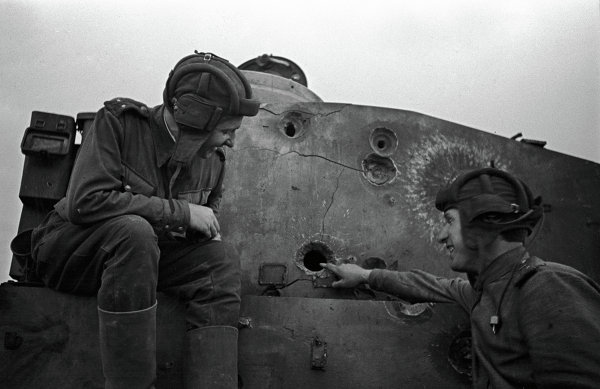
Soviet Tankers admiring their handiwork. 

I took the following approach to the campaign. I wanted to play Overlord games and at a pleasant pace, I could not see us finishing more than three games in a day.  We could play more, but only at the risk of chivvying players or playing into the night, with the result that everyone would be cranky and tired by the end of the evening. So with three game to play, I needed a campaign structure that gave the players some decisions to make, but that wasn't so involved that it ate up too much of the playing time. Short and snappy is the name of the game here. 


In the end, I settled on the "Kursk: The Movie" campaign.  The idea was to imagine I was making a film of the Battle of Kursk. Obviously, the massive tank battle at Prokorovka is the first thing that springs to mind. Now as it happens there is already a Prokorovka scenario available, so that cut down the amount of work required by a third. But Prokorovka is a finale, not an opening scene.

Mulling over it - the other image of Kursk that always came to mind was columns of panzers moving through wheatfields and then running into miles and miles of defenses,  so I wanted to get that idea in somewhere. I've always had an interest in the battle of Ponyri, since I first read about it in a Crossfire supplement. 

Ponyri is an odd battle, an island of brutal urban combat in what is mainly remembered for long range tank engagements. Essentially the battle revolved around possession of a train station and resulted in a days long fight in and around the station that was later compared to Stalingrad by men who had been there. While all of this was going on, the Germans were trying to flank the town, but ended up fighting through more anti-tank guns, minefield, etc, so in many ways Ponyri shares some characteristics with the first battle. 

So my rough plan looked a bit like this. 

Battle One - A German attempt to breakthrough a Soviet defensive line. 

Battle Two - The Battle around Ponyri

Battle Three - Prokorovka 

The assault on Cherkasskoye on the 5th of July seemed to fit the bill very well.  There were other defensive battles of course, but this one had the advantage of having a big shiny picture in the Osprey and that is recommendation enough for me.  

The idea was that each team, Soviets and Germans, would be assigned a number of reserve tokens and air sortie cards. They were also given a menu of reserve units that they could buy and assign to any of the three scenarios. The first two games were worth a point each, while the last was worth two.   

An somewhat artificial construct, but it served. 


Wednesday, April 30, 2014

All quiet on the blogging front


We mainly like sleeping on each other. 

I may have mentioned that there is preciously little blogging going on at the moment.  Quite a bit of that has had to do with working all the hours that God sends at the moment. I will be very happy when by mid May when this rush of stuff is over.  In other news, we are looking after some foster kittens again for the DSPCA. Now we have a rule that we never take fewer than three kittens, mainly because we're well aware that five cats is just too many. At least if we have three, we know we have to give them back. 

Now as it happened when I explained this to the new girl at the DSPCA, her ears pricked up and she said "So you'd be happy to take more than three?"  


Running, jumping, climbing humans - the days are just packed!

And that ladies and germs is how we ended up with six foster kittens - they are

Hillary - who likes climbing things. 
Myrtle - who moans and cries all the time. 
Louis - (short for Richelieu) because he has a black spot on his chin. 
Louis is their leader. 
Mary - who cleans things mercilessly. 
This is definitely not a reference to my mother in law. 
Spike - because his fur will just not stay down. 
Monty - short for "The Comte de Monte Kitten", so named because 
we couldn't come up with a name for him after the first few days. 


But also sleeping. 


...and occasionally washing. 

We will only have these chaps for five weeks, but they're already proving a hit. They are also much cleaner than the previous crew. 


Niiii-arrrrroooo!

But lest you think that there will be no wargaming at all in this blog, I present you with a picture from our Kursk campaign on Sunday. My semi-finished Stuka taking the fight to some Soviet lend lease armour in the final game.  This was a great success and went well.  This was one of the first times we've used the air rules in an Overlord game and they made for some interesting play. I was very happy with it, but that's for another post. 


Tuesday, April 29, 2014

Hedgerow


Some fearsome looking bocage

Things have been rather busy here at Joy and Forgetfulness, so blogging has had to take a back seat for a while. Sad to say, work has been responsible for most of it, but we did manage to get some gaming in on Sunday, which was great fun and I will be posting about that in a few days. 

In the meantime, as any fool who fancies wargaming the Normandy campaign knows, you need bocage. There are a variety of tutorials online, but to be honest I knew it was going to be a dirty job (most of them involve a lot of mastic) and have been avoiding it for a while. 


Another angle

This looks suitably tangled and awkward and unpleasent and was produced for less than the price of a pint by Skips Scenics.  They are a local outfit (buy Irish chaps) stocked by The Hobbyden, an online dealer in Kildare.  I was also able to send them some of my five inch MDF hexes, so that the bases would match my Memoir '44 setup and they just built the pieces on top. On the whole - I'm very happy. I got three of these for €20 including shipping and that's as many as I need for the first four scenarios in the Caen campaign. I'm not entirely sure what they are made out of, but I think it's a mix of filler and rubberised horse hair. Either way, it's very hard and will stand up to a great deal of abuse. I'm going to add some texturing to the plain wood of the hex, but beyond that they are ready to go straight from the box. 

Recommended. 


Sunday, April 20, 2014

Happy Easter


The angel at the sepulchre by Gustav Dore

Christ is risen! Wishing you all a very Happy Easter.