Showing posts with label muskets at the movies. Show all posts

Tuesday, July 14, 2015

Muskets at the Movies: Black powder battle on film - Part Three - The Final Countdown


Kinch has 'is popcorn and is ready to go

Unlike Bob or Foy, I am really terrible at maintaining blog posts that are series. Not for me Hoopdoodle #241 or "I have been to...", I tend to get distracted by something shiny and forget to do anything further. So in the interests of breaking that particular habit, here is the final post in the series "Muskets at the movies."


4.War & Peace 

To be honest, this is on the list for the sheer mass and scale of humanity that are present in the battle scenes. I haven't watched it since I read the book, but my overwhelming  memory of the film was spectacle. Particularly in these CGI days, it is worth noting that those are real men and real things happening on screen. 

The Russians certainly do things in a grand style. 


3. Glory 

I love this film and there is a lot to love about it. It has an intense evocation of time and place, a powerful ensemble cast, a brilliant score and great script.  I was surprised that Denzel Washington got the Oscar, not that his performance wasn't good, I just thought that Freeman and Broderick were better. But disregarding it's value as a very fine film, Glory does seem to me to be a convincing portrayal of black powder combat in American Civil War.  The general amateurishness of the armies, the long range fire fights, the sudden and brutal hand to hand combat are all captured perfectly on film. 
But the stand out moment for me in Glory is a scene in a hospital where the action isn't shown. It's all done in closeup and I really captures to my mind the horror of the pre-chloroform surgery.  The story is told entirely through Mathew Broderick's face and the dialogue. It would have been easy to have done this gratuitously, but everything about this particular piece of cinema is perfect.  I have not been able to find a better quality recording of the clip, but there is a clip below. Be warned, it is not for the faint of heart or the easily upset. 


2. Barry Lyndon

Barry Lyndon is a film like Glory - it's just a great show.  The acting, the music (I can't hear Sarabande without getting chills), the sets, the whole thing is just fantastic.  But in addition to being a great film which you should see regardless, it does get a lot of things right in it's portrayal of black powder battle. The stand out scene for this is the "nameless skirmish" where British and French infantry face off against each other during the Seven Years War.

There's a lot to like in this scene, but the fact that they have the appropriate number of men, performing (to my inexperienced eye) the appropriate evolutions at the appropriate pace and you get to see it up close and in long shot is worth the price of entry alone. The stately pace of 18th century battle along with its gruesome aftermath are enough to stir the blood of any wargamer.


1. Waterloo

The scene above is the most extraordinary depictions of black powder battle I have ever seen. War and Peace may have had similar scale, but the tidal wave of horseflesh washing around the infantry squares is simply breath taking. The battle scenes are excellent, the acting is top notch and the casting is second to none.

In as much as a film can, I also think that Waterloo also manages to give some sense of what occurs when a general is commanding, the decisions that he makes and the agony of making hard choices with limited information under time pressure. Steiger is a marvelous Napoleon, Dan O'Herlihy is superb as Ney and I will always have a soft spot for Christopher Plummer (Wellington) and Jack Hawkins (Picton).

The shots of the attack on Hougomont are particularly good.  The action fills the frame in the foreground, but you can still see the reserves moving up in the background.  To have accomplished such a thing in a time before CGI is an extraordinary achievement.

I can't say enough good things about this film to be honest.

So there you have it.  A short and very subjective whistle stop tour of black powder battle on screen.

Any glaring ommissions?


Thursday, May 21, 2015

Muskets at the Movies: Black powder battle on film - Part Two


5. With Fire & Sword

I have no idea if this is representative of 17th century Eastern European conflict - but the scenes with the winged hussars were breath taking.  I always thought the winged hussars looked rather silly, but actually seeing them in the flesh making it clear just how intimidating these fellows were.   I have been unable to find a full version of this film with subtitles, but I would quite like to see the whole thing. The film is based on a novel Henryk Sienkiewicz, who so far as I can tell was Poland's answer to Sir Walter Scott. I have it on my kindle, but it's in the queue with Mor Jokai and some of the Russians.


6. Ride with the Devil

Now Ride with the Devil is a film about the Kansas-Missouri war during the American Civil War.  It was a bloody guerrilla conflict that was intimate as it was brutal with Confederate partisans called "Bushwackers" fighting with pro-Union "Jayhawkers". The battles portrayed in it are skirmishes, but they seem to convey the frantic nature of the fight in a way I've rarely seen captured on film. Jonathan Rhys Myers is particularly good as fanatic partisan.

Compelling stuff.


7. Last of the Mohicans.

This is one of the first films I ever saw in the cinema on my own.  It was a revelation when I was small and I went to see it several times in the cinema.  I with some friends that I played Warhammer Fantasy Battle and we argued all the way home on the bus home about the volumes of smoke produced by the cannon.  I had been lobbying for the introduction of smoke rules (culled from Featherstone's Complete Wargaming) into WFB to make our battles more "realistic".

The folly of youth.

The siege in particular was very impressive. The regulars get a pretty bum deal in the movie as a whole.  Hans Zimmers score is fantastic. 

Saturday, May 16, 2015

Muskets at the Movies: Black powder battle on film - Part One

The ornery wargamer confronts the perplexed cinephile. 


Wargamers are an odd bunch.  Tribal, querulous and deeply opinionated, but I think one thing we all agree on is that we love films.  While a lot of us have rather high opinion of ourselves as "historians", we often demonstrate as a tribe a deep love of battles on film, no matter how inaccurate or wonky. Zulu, for all its faults, launched a thousand wargamers. I still get chills whenever I hear men of Harlech...or the coming thunder that "sounds like a train in the distance". 

Films must be films.   They are required to make a crust for those who make and them and entertain those who care not a fig for the the correct facing colours on the Chassuers in the second scene. That said, having seen Hollywood horribly mangle police work (something I actually know something about), I think there's an argument to be made that they often get quite a lot right. 

With that in mind, I offer to you, my own list of top ten movies with black powder battles.  It is highly subjective, intensely personal and was not, I hasten to add, picked on artistic merit.  What I have picked is films that I think demonstrate some aspects of blackpowder warfare. 


10. The Patriot

This film has gotten a lot of flak over the years and deservedly so.  However, appreciated as an American propaganda piece, it does its job. But, more importantly for our purposes, it does get a lot of things right.

The troops fight in line and discharge musketry at cruelly close range.
The guns fire solid ball and it's results are shown with awful effect.
Musketry produces smoke and lots of it.

For those points alone, it would be worthy of inclusion, but to be fair, ignoring the antics of SS Penal Battalion Child Catcher Von Tarleton - there are some nice moments in this film.  I like Mel Gibson films, he's made more good ones than bad, and I think some of the comic acting with his children is done with a wonderfully light touch. The scene with the rocking chair is very nicely done and worthy of inclusion in a better film.

More of that please, Mr. Gibson.


9. Ran

This is pure hallucinatory genius. The toll of the musketry is shocking - the presentation of the battle almost as an abstract painting is one of the most extraordinary things I've ever seen.  I have no idea if Early Modern Samurai Battle looked anything like this, but it is worth seeing.  Kurosawa also managed to tell the story of a battle well, I understood what was going on, and to a greater or lesser extent it made sense.

That is a hard thing to do and to be commended. As to it's realism? Of those things of which we cannot speak, let us me silent.


8. Charge of the Light Brigade (1936)

This made a very profound impression on me as a small boy. It's total hokum of course, but it is glorious, a curious mashup of the Mutiny (or maybe the first Afghan war?) and the Crimean War. It's based on the Tennyson poem anyway rather than any -ahem- deep reading of history. Something of a guilty pleasure - I love the final scenes, but now know how many horses were killed to create them.

There will never be a more exhilarating charge on screen.

Part Two to come. 

Friday, January 18, 2013

Gangster Squad: A Review


Emma Stone looking very dolly


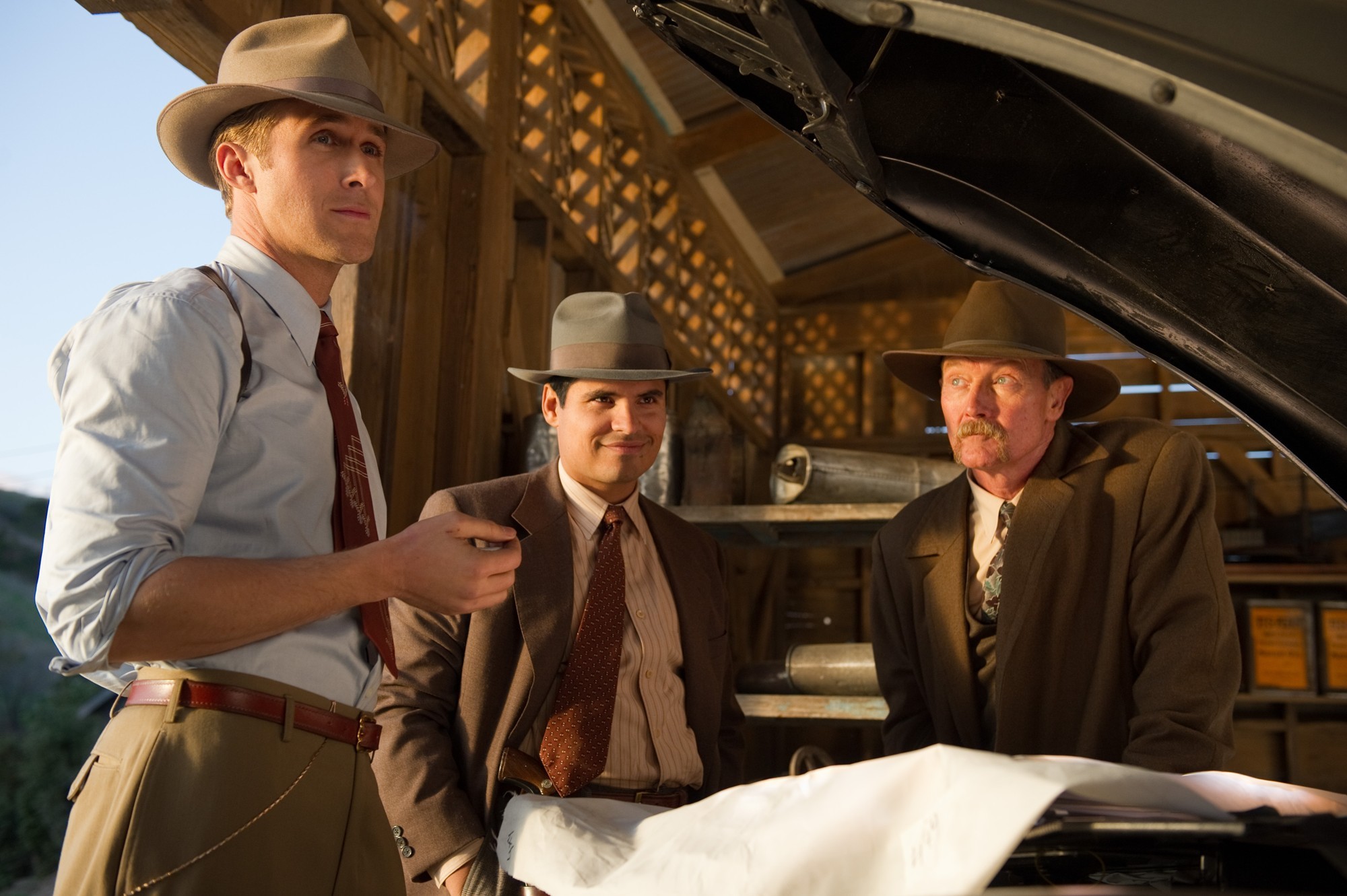
Mrs Kinch, Cousin Basil and I went to see Gangster Squad a few days ago.  The girls had been to see Les Miserables the day before and I was determined to see something with an appropriate number of explosions to take the edge off yet another rendition of "I dreamed a dream."

Gangster Squad tells the story of a group of Los Angeles policemen who wage private war against a New York hood named Mickey Cohen (Sean Penn) who is determined to take over Los Angeles. Led by Sergeant O'Mara (Josh Brolin), they fight terror with terror.

The opening sequence portrays Mickey Cohen ordering a East Coast hood torn apart by two cars. This rather spectacularly signposts the fact that while the film touts itself as "...inspired by true events," director Ruben Fleischer definitely decides to print the legend and not the facts.


But here is the real wife material (Josh Brolin & Mireille Enos)

Gangster Squad is beautifully photographed, well acted, slick film. Josh Brolin is magnificently craggy as Sergeant O'Mara and Ryan Gosling brings a light touch as Sergeant Wooters. Sean Penn's portrayal of Mickey Cohen as a twitching psyschopath owes rather more to Cagney's Cody Jarret than the real Mickey Cohen, but is still riveting. Emma Stone has received praise for her performance as a femme fatale over her head, but Mireille Enos as Connie O'Mara, Josh Brolin's pregnant wife, blows her off the screen.  In a script not marked by brilliance, the scenes of effortless intimacy between her and Brolin, brief though they are, were the highlight of the film for me.  In a world replete with dull "beautiful, but deadly" heroines, she is a breath of fresh air - funny, loving and tough as nails.  I'll take fascinating over pretty any day, though with Enos you don't have to choose. We could do with a dozen more like her. I'd love to see her play Lady Macbeth

But what about the rest of the cast? Well therein lies a tale. 

Sgt O'Mara is given a commission to raise an off the books unit of gangster hunters and the team he assembles gives the game away.  I know nothing about Ruben Fleischer, I haven't seen anything any of his other films, but like it or not, he has made a decent fist at a western.


"I'll dance with the one that brung me"

If Millers Crossing was in the words of its director, a film about men in beautiful hats,  Gangster Squad is a western that eschews stetsons. I realised it within twenty minutes of the film beginning - the diverse nature of Brolin's posse, including one genuine cowboy played with admirable humour by Robert Patrick, whose father-son relationship with Michael Pena kept me smiling, evokes John Sturge's Magnificent Seven. The landscape of Los Angeles, except for its brothels and juke joints, is as empty as John Ford's Monument Valley. The Gangster Squad beat, intimidate and shoot their way across a town that doesn't seem to support passers by as part of the local ecosystem.  Sean Penn hits the nail on the head when he warns off another gangster with the line, "This isn't Chicago, this is the wild west."

It cheered me up no end, I couldn't work out why I kept thinking of Lee Marvin when I looked at Josh Brolin.

Gangster Squad is a good film and well worth seeing, though it has two major failings.  An urban western, it's slick and it's beautiful and as stylised as Sin City ever was. It would have had a better time of it had it not used Mickey Cohen's name or claimed to have been "...inspired by true events." Far better to have set in some nameless city or a Hammet inspired Personville rather than LA, which would have avoided the ridiculous criticism that it ignores the LAPD's history of racism or the real circumstances of Mickey Cohen's fall or any number of other charges being levelled at it.  A case of a chicken being slated for not quacking like a duck.


Kicking it oldschool with the C dog


As Marlow put it, "I believe I undertook amongst other things not to disclose any trade secrets. Well, I am not going to."

The Gangster Squad win - they catch Mickey Cohen and he's put away. If this has ruined the surprise for you, my apologies; also welcome to the world of film, I hope you enjoy it here.

This is where the film falls down - if you have the chance, as soon as Mickey Cohen is arrested, leave the cinema, you'll be better off. There follows the obligatory "where are they now", where we're told what happens to each member of the squad. It's nauseatingly saccharine and I hated every minute of it. A normal gangster film could get away with this, it's unpleasant, but it's necessary. But for the western that Gangster Squad really is - underneath it's tommy guns and snap brim fedoras, it's positively criminal.

The classic Western is a film about the tension between civilization and barbarism. In Kenneth Hite's essay, "The Man Who Shot Joseph Curwen"*, he writes.

"... the central  agon of the other great American narrative art form (besides fantastic fiction), the Western film. The agon, the central conflict, of every classic Western from The Toll Road in 1920 to Unforgiven in 1992 is as follows:

• Barbarism can only be defeated with the gun.

• All those who pick up the gun are barbarians."

The Gangster Squad have stepped beyond the law, they have wrought a bloody vengeance on the men who would destroy the civilization they are sworn to protect and it is right and fitting that they do so.


Goodbye Tom Doniphan 

But they must be destroyed.  For the civilisation to thrive it must push the barbarians out, even righteous barbarians.  Connie should have left John O'Mara or should have died in their bungalow when it was machine gunned. The squad went beyond the acceptable and far beyond the decent to achieve what needed to be done, but that comes with a cost and regardless of how well intentioned or how noble the motive, that debt has to be paid.  The sacrifice has to be real for the act to be anything else other than adolescent wish fulfilment.  Ruben Fleischer had the chance to make a fine film and settled for making a good one.

In "The Man who shot Liberty Valance", John Wayne dies alone.  

I regret to say Sgt. O'Mara wasn't given the chance to die with him.


 *Available here


Wednesday, December 21, 2011

Muskets at the Movies #1: Glory


Some scenes from Glory


Given that movies and wargaming were a topic of discussion recently, here is the first of what I hope to be a series of posts about "great wargaming movies".

Glory is a 1989 film set during the American Civil War. The film follows the exploits of the 54th Massachussets, a regiment raised from mostly from free blacks in the North. The film follows the regiment from its founding to the assault on Fort Wagner. It is a strong ensemble piece, the cast are superb, Denzel Washington crackles and Mathew Broderick gives a wonderfully understated performance as Colonel Robert Gould Shaw, a white abolitionist, who is offered command of the regiment. I think one of the tricks that were missed in this otherwise magnificent film was that Gould-Shaw turned the job down, only to sleep on it and reconsider.

Glory is full of good things, not least James Horners haunting score sung by the Harlem Boys Choir. I challenge anyone to hear that beautiful, soaring music and remain unmoved.

From the point of view of battles there are a couple, but they are not what shines about the film. The fight in the forest is well shot, but as any student of horse and musket warfare will tell you that bayonet charges rarely crossed blades. At the same time, if the mechanics are wrong - the emotional pitch is right. The mixture of terror and savagery is breathtaking.

The assault on Fort Wagner is a fine piece of cinematic story telling. It vividly illustrates the dangers of escalade and the tendency of troops to bunch under pressure until driven on by a "Big Man". The ditch at Fort Wagner could be the ditch at any siege, full of confused, struggling men waiting for direction.

So, looking back at my three criteria for a good movie, how does Glory measure up?

1. Does it work as a story, does it entertain?

Glory offers a gripping narrative. There are fine performances throughout. The struggles of the 54th with army bureaucracy are dramatised well. Mrs Kinch, not a fan of war movies, watched the whole thing and pronounced it excellent if terribly upsetting.

2. Sense of time and place.

This is more of a mixed bag - Ed Zwick tries very hard, but there are a couple of clangers in there. The whipping of Private Tripp is one that I found very hard to understand as I have never come across any other description of flogging in the American armies of the time. There's the usual issue with well fed reenactors, but on the whole it's OK.

3. Wargaming

There's a good portrayal of an escalade and a short nasty action in the woods. The battle of Antietam is evoked in an attack that fails, but as I said earlier the real meat of the movie is in the pre and post battle scenes. There is a chilling scene set in a field hospital where Mathew Broderick is being treated, the only scene of its type I have ever seen on film.

Glory is a film that is worth watching and will certainly fill you with enthusiasm for the period. It remains one of top five favourite films. I heartily recommend it.