Old school’s not out for summer etc
-
The figures from the previous post are now just about ready for the table
top.
Opps noticed the shield boss on the elephant rider needs painting, easily
...
A Great Game!
-
I just come back from the local Wargames club, where I've just a had a
fantastic game of Bonnie Blue Flag. After all these years of following it
with a g...
Battle of Hastings (TtS!) 18mm WoFun
-
Good day folks!
My friend Phil and I broke out the 18mm WoFun Anglo-Saxons (Wessex) and
Normans to refight the *Battle of Hastings* which occurred in the...
The Portable Ironclads Wargame: Definitive Edition
-
*What a winning combination of useful titles with which to base a project
around! Methinks these will be rather well-thumbed by the time the models
are r...
Hooptedoodle #500 - Oddie Man Out?
-
I am sorry to note that Bill Oddie, entertainer and birdwatcher, has died.
I confess I did not know a great deal about him, I found his TV persona in
hi...
ONE LOVELY DRAWING, part 80
-
July 27 is the tenth anniversary of the death of gifted cartoonist Richard
Thompson. His tragic death at age of 58 was a great loss to the field of
illu...
Prepping for Aspern Essling & Eggmuhl
-
We're hoping to do Aspern Essling and Eggmuhl next month, which has meant
that I've been doing some quick work bringing the Austrian collection up to
sp...
The Officer's Mess
-
When I made my list of "periods" I was unsure about my assorted melange of
troops from the War of 1812, the US vs Mexico war and the 1830's Canadian
rebe...
6th Jagers and fighting Churchill
-
The Russian 6th Jagers are finished. The figures are about one third
vintage castings and the rest are modern reproductions, all nice castings
though. Th...
Again flats - This time Borodino
-
A week ago, I had the chance to have a short holiday in Dresden with
friends. We visited the museum of the Bundeswehr, the Fortress Königstein
and the "...
Historicon Report Part One
-
*His Nibs at Historicon with his Battle of Trenton gameBest of Show Award
winner at this year's Historicon*
I returned home yesterday from the Histo...
Reconsiderations: Death and Resurrection
-
Needless to say, I've been very remiss in writing new posts for this blog,
even within the context of the less rigorous schedule I proposed two months
ag...
3D Resin Printing - summary of the last batch
-
Having written my half year review I wondered how much I had actually
printed. So here is a summary
- 5 x M3A1 Stuarts - for my British desert force...
General Pettygree says, "Happy July 4th Birthday"
-
"Happy birthday, General MacArthur, to you and your countrymen."
Thank you, General Pettygree. You know, I am suddenly reminded about The
Gettysburg Ad...
An Early July Hussar Update. . .
-
*Marginally neater in appearance with green bases, girths, and ivory horse
markings added, but I need to neaten up some hooves now before moving onto
t...
Portable Aspern-Essling, 21 May, 1809
-
The battlefield: Aspern on the left, and Essling in the distance
The infantry of Massena's IV Corps about to occupy the villages
This is my 'Portable' rend...
Sanctum of the Heresiarch (a one-shot dungeon)
-
So in the Lands of the Heresiarch, the Xenomorph-worshipping cult (think
Alien: Resurrection but in the middle-ages) has built its shrine around
the cra...
The Battle of Nobb's End October 1642
-
It has been some years since any of my English Civil War collection has
seen the light of day or felt the table beneath their bases. Since I was in
the ...
WW2 ‘German’ Don Cossacks
-
I've had these in stock for a while now and as I may have work for them in
a forthcoming game it was clearly time to paint them!
They're certainly a co...
Mooching aboot.
-
I've spent a nice afternoon looking through this old blog, the best bit,
though, was looking through some of my old blogging mates' blogs.
I had a good ...
Very Sad News
-
I'm very sorry to be making this post but I've just learned that Dale past
away from a heart attack on November 5th.
Most of my relationship with Dale wa...
Trying Something New
-
Based on what I said last time, I’m going to try out something new. Check
out my posts at Medium – one test you can ignore, one discussion of why I
chose t...
Short Rules by Leon Tucker
-
A bit of an experiment as posts go… This is an overview of one of my
favorite, older, short, simple war game rules. Plenty of information to get
a feel f...
Warplan 5/5 Campaign System
-
I'm afraid I couldn't find a way to reproduce the snazzy double headed
arrow in 5/5 in the text so will have to do with this instead.
Warplan 5/5 came o...
What Do You Mean “It’s Only A Movie”?
-
Like many of my friends and fellow students of military history/military
affairs, I went recently to see the new movie “Midway”. This community can
deli...
Tribute to Stuart Asquith
-
Whilst it is not news that we have recently lost one of the hobby's
best-known figures this past week, I thought it would be appropriate to add
my own trib...
The Fritz Leiber WIKI - [Currently Reading]
-
---------- The Fritz Leiber WIKI Welcome to the Scrolls of Lankhmar. It
contains information on the writings of and also the RPG Guide to Nehwon,
which is ...
A Tale of Two Battles - Part the First
-
The Italian infantry brigade.
The only unit to come out of this with their heads held high.
This is the first of two battle reports featuring my French ...
Supplies to San Lorenzo ....
-
*San Lorenzo, lies near the border with the British territory of
Malize..... The British have allied with some local natives attempt to
disrupt one of the ...
Character Figures and Settlers for the FIW
-
Conquest Miniatures put out a nice little blister of the main characters
from the Last of the Mohicans, also released by Warlord Games. I had fun
painti...
Sources For The Interwar Gamer
-
I have been meaning to add some content here for a long time, apparently
three years of a long time in fact, how time flies. So with this post I
hope to k...
Stephen King’s Threshold
-
“There is probably no dedicated fantasy fan in America who doesn’t have at
least one of those distinctive black-bound volumes upon his or her shelf .
. ....
The Return of the Iron Duke
-
On Saturday, Nov. 21, six of us gathered at Jay's to fight a Napoleonic
battle using a highly modified version of Command and Colors Napoleonics we
laughin...
High time...
-
It is high time I posted here again. The project has stalled. Last night I
decided to have a read of book 2 after many years away from it. It begins
so wel...
Top (TV) Duels
-
To go with my posts on top one-on-one fights (in films) here's a quick
selection from television.
*#5* Agents of SHIELD (May vs. Ward)
This was a fascinat...
La Passeggiata
-
Artist: ItalianTitle: La *Passeggiata*
★Thank you for Visiting!★ ~ Return to Website ~ Return to Blog
Thank you for subscribing to the Orientalist Gallery!
Memories, Tangents and the Power of the Pastoral
-
*Charles Stadden 30mm BEF released fifty(ish) years ago*
It occurs to me that wargaming the Great War is not going to be a straight
forward thing.
L...
Second World War comparisons on "World War 20mm"
-
Piers Brand has recently posted a side by side shot of several figures
painted in his inimitable style. They represent a number of different 20mm
metal ma...
Fauna
-
After a recent expedition "down under" a couple of new animals have been
added to the national zoological gardens.
*If I recall correctly these are from a R...
Byzarbia at Ayton Game.
-
Once again it's been a while, though in my defence I plead that I have been
busy painting figures for our second Ayton Weekend Game, even forgoing two
of o...
Blog Harassment
-
I am sorry to say that I have had to select comment moderation as a
permanent feature now. I am sick and tired of being harassed by a follower
of this blog...
Buy my e-book and save the police (again!)
-
*Wasting Police Time** is now available on Kindle.
You don't need a Kindle itself to read it - you can download an 'app' onto
your iPad/laptop/whatever.
U...
10 of the most beautiful things I've ever seen
-
1. The sun setting over a still sea, woven to silk, and the swimmers,
silhouttetted wading back to the shore like merman returning to land.
2. My br...
Why the WAR OF 1812?
-
I just received two of the more recent Osprey Men-at Arms books on the War
of 1812 in the mail the other day (not really that recent - 1998 and
2000...but...
I have started experimenting with YouTube a little, mainly because it offers the chance to record something short and to the point without too much prep. A friend of mine asked my opinion of "The Wargaming Compendium" by Henry Hyde - in short it's rather good, but pricey for the new wargamer who will benefit most from it.
Short and lively, this a popular history for younger readers of the conflict between the infant US Navy and the Barbary Pirates of North Africa. The prose is simple and crisp as is usual with Forrester and the narrative gallops along at a satisfying pace. Adult readers will no doubt want something more in depth on the subject as this treatment is necessarily superficial, but even adult readers can benefit from a simple story well told.
Good for younger readers or as an introduction to the subject.
Ian Watson offers my favourite interpretation of the 40k universe, though Dan Abnett is a close second. Chaos Child, the conclusion to the Inquisition War trilogy, is a curates egg - good in parts. Watson's command of description and character is as good as ever, but sadly he doesn't stick the landing.
Plot is not Watson's strong point and he is far better at describing the dream like absurdity of the setting than he is at paying off the story points he's laid down for himself. The book as a whole undergoes a significant tonal shift half way through as the over arching plot he has been playing with for the previous two books is sidelined in the pursuit of what seems like a far more personal quest.
The characters are all still interesting and writing is as good as ever, but ultimately, nothing really changes as a result of the events of the book and that is a shame. If you are a fan of the setting and would like to take a tourist trip through some of its weirder locales, this is a book well worth reading, but if you just want to enjoy a story - there are better uses of your time.
This the second novel from Chris Wraight that I've read recently and he has just gotten better. He deftly switches between three point of view characters and weaves a fast moving tale of violence and intrigue. What was also interesting was that this is one of the few warhammer novels that advances the grand narrative of the setting in any way, something which Wraight manages with a surprisingly light touch.
There is less of the overwrought description that was characteristic of his earlier efforts and ideally it could do with even more trimming, but ultimately this is finely honed and well delivered spot of far future action which kept me mightily entertained in my off hours. More of this please.
A great deal of ink has been spilt on the subject of Jordan Peterson and this book. I can not add much to what has been said, but to say that I would unreservedly recommend it.
This is a self help book after a fashion and a lot of what it advises is plain common sense. There is a great deal of value in hearing good advice again and I suppose every generation has to learn the same lessons again. It’s radical firebrand stuff like tell the truth, stand up straight and pursue what is meaningful.
I found the book accessible and eminently practical. The audio version is well produced and read by the author, though it lacks the illustrations, introduction and footnotes that come with the printed edition.
This book (and the work that preceded it, but that is codified within it) helped me when I was in a tough spot with injury, work and family. It has made me a happier, more useful and ultimately a better man.
As Mrs Kinch put it, “you can’t argue with the results.”
If you want a flavour of what the book is about, you could do a lot worse than watch this video, which is about eight minutes long.
This is Lewis, who goes by the name of TIK on YouTube. He got extremely browned off with the sort of nonsense the History Channel were broadcasting and decided to try his hand at making his own Second World War documentaries.
The production values are very good for a one man band and his presentation is good. What makes Lewis stand out is that he goes into considerable depth on his subject (the link above is 90 minutes long) and is upfront about his sources (all of which are listed in the video description). I particularly liked the section at the end of this video where he discusses the discrepancies between his sources and his own interpretation of the evidence.
Here's another of his pieces on Operation Battle Axe. There's also stuff on Eban Emel, the Soviet Purges and Operation Barbarossa as well as (computer) wargaming.
After confronting the essential poverty and meaninglessness of existence in a post modern age, a young mouse embarks on a quest to find "her tiger". Disregarding hedonism and the tawdry distractions of other lesser tigers, she demands that which neither a deracinated capitalism nor a cold and ruthless socialism can provide. This focus on the local and the particular clearly underlines the pre-modern essence of the text.
A Scrutonian voyage of discovery for the under twos.
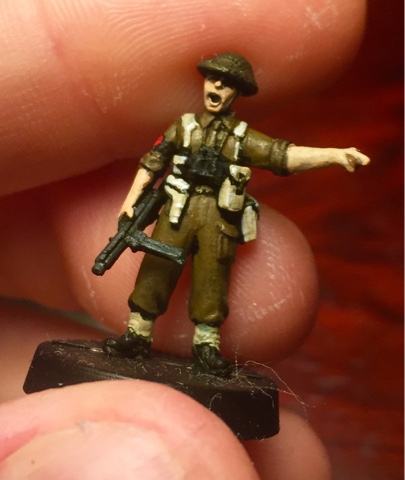
I took delivery of these chaps recently. They are some special Second World War British character figures from CP models and very lovely they are too. They were painted by my pal Tamas and I think he did a fine job.
First amongst them is this diorama piece of a lightly armed commando killing a German sentry with a Fairbairn Sykes dagger. I haven't the faintest idea what I'll be able to use this for in a game, but it brought to mind all my bloody thirsty antics as a small boy reared on Commando, Warlord and Battle! comics.
My father still tells the story of finding me, aged eight, in the grip of a high fever one night. He had checked my bedroom only to find it empty and searched the house in a bit of a panic. He found me in the living room hiding under the sofa.
"Dad are you crazy ? Get down - the Germans will see you."
Apparently it took some struggle to get me back to bed.
I have a few military police figures - this chap is the latest addition. The redcaps are a much maligned branch and I've always wanted to do a game about them.
Possibly for traffic control? Or rear security.
I've been reading through some of the war diaries of the Provost companies during the Normandy campaign. It's a catalogue of points duty, dealing with looting and disorder and a steady trickle of casualties from shelling. I have been pondering how one might approach that in the context of a game.
Another rarely seen figure on the wargames table, the army padre.
Curiously enough, I have learned that a Kinch ancestor served in the Great War as an RC chaplain and paid for his devotion with his life. Something we shall have to dig into a little more deeply.
This chap is described in the set as a despatch rider, but he seemed to be doing points duty here. I shall have to scare up on the old Airfix motorcycle for him, possibly leaned artistically against a wall or some such. He may end up being inducted into the redcaps.
This is a fine little set showing some of the rear echelon elements of an army. I would certainly recommend them and Tamas has done a fine job. Hopefully Joy & Forgetfulness will be a little more active over the next few months - Kinchlets permitting.
My copy of Bob Cordery’s “The Portable Wargame” arrived some time ago. I’ve been following Bob’s progress with this for a while now and it’s been interesting. Bob clearly thinks very carefully about how he designs game mechanics and what ought to go in and to an extent, which is almost more important, what should be left out. The result has been an elegant beast indeed.
First impressions? A very nice clean piece of book design reminiscent of Charles Grant's "Battle". Clear text with decent margins so that the text has room to breathe on the page and is sharp and easy to read. It is illustrated throughout with black and white photographs which are surprisingly crisp for a print on demand publisher, I was very impressed with that. My copy is a small hardback about A5 in size. The rules look straight forward and the worked examples are clear. I haven't spotted any typos in my read through. This may sound like a strange point to harp on, but for a print on demand book I was very impressed with the print quality. I got the hardback and the quality of the binding is very good indeed.
The book itself is broken into a couple of different sections; a history of gridded wargames, an explanation of the various pros and cons of using squares versus hexes, a potted history of the development of the Portable Wargame and two sets of rules, one set for the late 19th century and a set covering from roughly the Great War to the Korean War. .
It should be borne in mind that the rules for both periods are interchangeable. There is a great deal of commonality between the two and that it will be in the details (like handling tanks,etc) that the differences become apparent. This approach should be familiar to players of Commands & Colours or the Black Powder stable of games, where games share mechanics across periods.
These are simple rules, meant to be played on a gridded play surface that isn’t huge. The whole project began when Bob found an old chessboard and began to think what sort of wargames he could play using it as a small handy play surface. Consequently, the rules are simple and quite abstract. You won’t find finely grained distinctions between Bren guns and Spandau’s here, but you will find horse, foot and guns (or artillery, infantry and armour in the Second World War variant) with each occupying its own niche in the battle plan. The result is quite like the sort of broad strokes approach taken in the 1956 British Army war game and a couple of professional wargames rules I’ve read.
Curiously enough, probably one of the best sections of the book is a two page spread on the author’s “principles of wargaming”. It is an absolutely fantastic resource for anybody with an interest in designing wargames because it brings a great deal of clarity of thought to the process. The author is someone who has thought deeply about his subject and I think it repays study. Bob Cordery is a retired teacher and I think his background in education shines through, because he tackles not only how rules are constructed, but also how they are used.
The Portable Wargame is exactly that, aimed at a small playing area (a chessboard would be perfect - the rules are drafted with the expectation of an eight by eight playing field) and small forces. Depending on what scale you use, twenty to thirty figures is a perfectly respectable army. This means that you can raise a number of forces for not much more than the price of a pint. In fact, the author discusses a number of different ways of representing units using multi-based figures, single figures and outlines some options with regard to casualty markers and roster systems.
The dice are all six siders, so realistically no special equipment is needed for this game, no templates or special dice. Just some figures, a board and a few small pieces of terrain are all that is required. The turn sequence is equally simple, fire artillery (this is simultaneous), then dice for initiative, the acting player then moves and shoots and then play returns to his opponent. The result is a stripped down, elegant game that cracks along at a swift pace. There is a card activation mechanic which can be used by players wishing to play solo.
Also included in the rules are two worked examples of games, one set in the Sudan in 1883 pitting Egyptians against Mahdists and another on the Eastern Front in 1943. Each game is completely described, turn by turn, so that you can see the rules in action. Briefings and orders of battle are included for both battles so that you can replay them at your leisure. If you need a few more scenarios, you could do a lot worse than check out Bob’s blog at wargamingmiscellany.blogspot.ie/ where he has described a couple in detail.
In conclusion, these are simple rules that cover a lot of ground. They will repay attention to basic tactical principles (economy of force, maintenance of aim, concentration of fighting power, etc) and give a good game in an hour or so on a small board, which was exactly what they were intended to do.
A worthy addition to the canon.
Addendum: It should be noted, in the interests of full disclosure, that Bob Cordery, the author of these rules, is a friend of mine.
“Too little, too late” is Mike Embree's account of the German portion of the 1866 Austro-Prussian war which marked the eclipse of the Austro-Hungarian Empire as the pre-eminent power in German affairs and began the transition to Prussian dominance. Physically the book is a handsome hardback, weighing in at a slim 200 or so pages and illustrated with period etchings and maps.
In it, Embree chronicles the brief campaign against Austria and the smaller German powers, the fruitless victory of the Hanoverian army at Langensalza* and the defeat of the Hessians and the Bavarians. The book begins with a potted history of the period, outlining the strategic situation in broad strokes, but swiftly changes to the author's strong suit, drilling down into the detail with copious reference to primary sources.
The situation in brief is as follows, in the aftermath of the Napoleonic wars, the German states banded together along with Prussia and Austria to form a loose union to prevent any recurrence of French aggression. This union was dominated by Austria and the conflict arose when Prussia seeking to wrest control of the union from that state, provoked a war in order to unseat Austria.
The composition of the opposing armies, including those of a bewildering array of minor German states (some of which barely rise to the strength of a brigade) are described in detail. The rest of the book is devoted to an operational history of this brief conflict, which lasted barely six weeks. The prose is a model of clarity and leaves the reader in no doubt as to what is occurring, though one complaint I would have would be the maps. Maps are a persistent thorn in the side of those who write (and read) operational histories – how many? Where to put them? And in how much detail?
The maps are fine and are clear, but they are all located (along with some uniform plates) in the centre of the book, rather than situated with the text which refers to them. They are also not appropriately referenced in the text, so that the reader has to puzzle out what map refers to which action based on the name of the action rather than a page number. A small point, but one that stands out in a publication as slick as this one.
What strikes me about “Too little, too late” is how contemporary it seems. Austria and her allies are constantly undone by Prussian hybrid warfare, with the canny Prussians using a mixture of diplomacy, threats, misinformation and lightning manuevre to unhinge and ultimately destroy the allied forces. The author neatly describes that mixture of traditional warfighting and diplomatic cunning in a way that makes the overall picture clear to the reader, illustrating the complexities without getting lost in the weeds.
But for all the Austrian disasters, the Prussians do not escape some criticism and the difficulties of controlling independently minded commanders whose tactical decisions are imperiling the strategic vision - a problem any leader can relate to.
Ultimately, this book is the best English language treatment of the campaign currently available and will be of interest to the historian and the wargamer, who will appreciate the wealth of detail on orders of battle.
*ground which the author has covered before in a pamphlet available from the Continental Wars Society.
Note: In the interests of full disclosure, Mike is a friend of mine. I asked him if there was a general history that might be a good companion to this more specialised volume. He recommended "The Campaign of 1866 in Germany", the official Prussian staff history as probably the easiest and least controversial.
The March to Kandahar: Roberts in Afghanistan by Rodney Atwood is handsome perfect bound paperback of about 200 pages. In it the author describes the part played by Lord Frederick Roberts (famous from Kiplings poem "Bobs") in the Second Afghan War of 1878-80. The book begins with a brief summary of of the First Afghan War, the Indian Mutiny and the internecine struggles of the Afghan court prior to the war and continues with an outline of events prior to Roberts arrival. Where the book really hits its stride is in giving a pen picture of Roberts contradictory but often admirable character and in describing the desperate nature of the fighting in Afghanistan. The result is an approachable history which is accessible to the layman. Atwood also grapples with the thorny problem summary executions which dogged Roberts Afghan expedition and the opprobrium those attracted in the British press.
I did not come away with a definite understanding of where the author stood on this point, though he seemed to state the case fairly for both sites.
The author style is light and readable, combining the clarity of non-fiction with a novelists eye for detail and character.
Lastly, the maps provided are clear and have sufficient detail to allow the reader to follow the narrative scattered as it is with unfamiliar names and geography. I found it easier to follow the written account of battles by sketching the main features of the map on paper as I read. It saved me constantly flicking back and forth.
I thoroughly enjoyed this book and would certainly recommend it to any newcomer to the subject.
There's a one-column brown blog To the north of Kathmandu; There's a little marble cross below the town; And a brokenhearted woman Tends the grave of the 'Mad Guru' , While the brown blog keeps rolling on. (apologies to Hayes & Clarke)
I have realised that it's been a while since I've done another blog recommendation, probably because there are so many good blogs out there. We really are spoiled for choice. But one that I have come across recently and which particularly struck me was "Maiwand Day" written by "The Mad Guru".
Maiwand Day is an unusual beast, a blog devoted to the recreation of a single battle, the battle of Maiwand. There is some really cracking stuff up there, but if I had to pick a top three, here are some of the best posts. 1. Some British & Afghan Conversions The Mad Guru is deeply steeped in the look and feel and history of his chosen period, the mythos of Afghanistan if you will. No where is this more apparent than in this piece, where is painstakingly recreates figures using conversions, green stuff and considerable industry to model particular figures from the history of the 1880s. Probably my favourite is the two drummer boys from the Kipling story, "The Drums of the Fore and Aft", a story that still brings a lump to my throat every time I read it. 2. The Battle of Charasiab While the blog focuses on the disaster at Maiwand, where Doctor Watson picked up his wound, the Guru has since expanded his focus a little and most recently put together a scenario for the Battle of Charasiab. This is less well known than that famous field of grief, but took place in in 1879 during Roberts march on Kabul. What's impressive about it is the care that has gone into the figures and the terrain, the playtesting (much under valued in my opinion) and the determination to produce an experience that was both evocative of the period, but also gave a good game. This has extended to making bespoke cards, proper quick reference charts and ensuring that those of us who cannot make it there in person, get to see high quality images of all those lovely models in play. 3. Bobbie Bobbie was the pet of a sergeant in the 66th Berkshire, who was said to have been present at the last stand of the last eleven. He later escaped and managed to make back to British lines, where he was subsequently decorated by Queen Victoria. The Mad Guru has commemorated him in lead, where he shall roam for evermore.
So if you have an interest in terrain making done well, colonials or just want to see one wargamers fascination explored in exquisite detail, you should have a look at Maiwand Day.
(looking at this picture, it is quite indistinct, I shall have to take a better one on Sunday).
My first knowledge of Maiwand came as a boy when I was always intrigued by this memorial in St. Patrick's Cathedral. Lt. Thomas Rice Henn, a Clare man who led a rear guard towards the end of the battle, is commemorated there. The group made up of survivors from the 66th Foot and Bombay Grenadiers made their last stand in a garden, until their numbers whittled down to eleven charged out into the enemy and were cut down.
The inscription reads as follows;
“QUO FAS AT GLORIA DUCUNT”
Sacred to the Memory of
THOMAS RICE HENN,
LIEUTENANT OF THE ROYAL ENGINEERS, THIRD SON OF THOMAS RICE HENN,
PARADISE HILL IN THE COUNTY OF CLARE, ESQ,
(ONE OF HER MAJESTY’S
COUNSEL AND RECORDER OF GALWAY) BY JANE ISABELLA, DAUGHTER
OF THE RIGHT HONOURABLE FRANCIS BLACKBURNE,
LORD CHANCELLOR OF IRELAND.
Having led into action a Detachment of the Bombay Sappers and
Miners – the last of all the Troops to leave the line of battle,
and of whom all, save eight, were either killed or
wounded – he perished gloriously on the fatal field of
MAIWAND
IN AFGHANISTAN,
July 27 1880,
IN THE 31ST YEAR OF HIS AGE,
Crowning his noble conduct in that disastrous combat by a deed of heroism,
than which (to quote the words of the Official Despatch) “History does not afford
any grander or truer instance of gallantry and devotion to Queen and Country;”
covering with a small, but indomitable band – eleven in number – the retreat
of the entire British Brigade and holding in check the over-whelming
Forces of the enemy, who did not dare to continue their advance,
until he and his brave comrades had been every one shot down.
HIS BEREAVED PARENTS, BROTHERS AND SISTERS,
HAVE ERECTED THIS TABLET,
MOURNERS YET GRATEFUL.
“NO HERO EVER DIED MORE NOBLY THAN HE
DID, - I ENVY THE MANNER OF HIS DEATH.-
IF I HAD TEN SONS, I SHOULD BE INDEED
PROUD IF ALL TEN FELL AS HE FELL.”
WORDS WRITTEN UPON HIS DEATH BY
LIEUT.-GEN. SIR GARNET J. WOLSELEY, G.C.B., &C.
“HE HATH DELIVERED MY SOUL IN PEACE FROM THE BATTLE
THAT WAS AGAINST ME.” PSALM LV. 18
One of the problems of maintaining a blog is that one meets people from around the world and some of them are dashed talented fellas. Now I'm sure I've mentioned how much talented fellas fill me with a burning sense of inadequacy and envy - well sadly, Krisztian has just decided to do it again. My very talented pal, Kriszitan Takacs of Budapest, has just started producing a small range of 1/300 scale figures for wargaming with his son.
The emphasis is on aircraft at present, because those are the games that they are playing, but who knows where the mood will take him. All I can say is that young Master Takacs is a very, very lucky boy indeed that and I am green from stem to stern.
Kris has some extras and is selling them, both painted and unpainted, at extremely reasonable prices. I believe the painted planes come in at something less than a fiver, which is very good value.
Mrs. Kinch and I were away for a few days in the country. It was a blissful holiday, which mainly involved sleeping for forteen hours a day and sitting in the garden, reading and drinking gin and tonic.
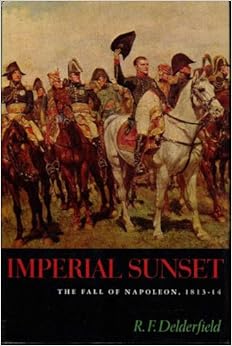
While we were away I finished "Imperial Sunset", RF Delderfelds account of the final years of Bonaparte's Empire. It was very readable and delightfully gossipy in much the same way as his March of the Twenty Six. It's always intriguing to read a book written by someone who disagrees with you on a fundamental level. Delderfeld is very much an advocate of Bonaparte and distributes praise or blame based on loyalty to him. He is also good at giving a sense of the social side of the Napoleonic Empire, though I'm skeptical of his analysis. Something I've noticed that when trying to get a series of events in history straight in my head is that it is often the lighter books that help me remember. I am much better at remembering a constructed narrative even if I think part of it is wrong. It is easier to account for a slanted narrative than to try and remember a series of events dispassionately recorded. The authors skill as a novelist is used to good effect.
Good light reading. Recommended.
Not quite as impressive as Stryker's collection of cavalry - but getting there
Hobby wise, there hasn't been much going on. I've set up the great basing project in one corner of The War Room. A couple of this years Ebay purchases and other bargains have been sitting in boxes for a while and need to be converted to the Kinch house style.
So there will be lots of little painted me being glued to bits of MDF, their bases covered in filler and painted and then hit with a spot of static grass. It's not a bad complaint to have to be honest, but it's not the most lively hobby activity either. I shall have to find something suitably riveting in the audiobook line.
I was talking to a friend of mine the other day and the subject of blogs came up - and rather more shockingly it became apparent that my pal didn't follow "The Campaigns of William Augustus Pettygree". In the unlikely event that any other blog readers would be so unwise - I thought I should bring it to your attention.
And what shall we find there?
Bill's "The Campaigns of William Augustus Pettygree" blog is a chronicle of the exploits of this particular officer as he serves Queen & Country on the North West Frontier and beyond. Bill's hall marks are...
- engaging photo narrative made up of posed pictures with figures in between games.
- truly vast games with hundreds of beautifully painted figures and massive tables.
The whole setup can be searched and viewed from the links at the side and stretches over an unbelievable sixty plus episodes. The games usually use modified Batailles de Anciens Regieme (BAR), but there are skirmish games in their as well.
Love that elephant
Probably one of my favourite posts was Outpost Number 3 which managed to combine a photostory with campaign logistics and a parade of wonderfully painted figures. Story AND game AND miniatures showcase all in one package.
Just fantastic stuff and if you want to see exactly how good the hobby can be, you owe it to yourself to take a look at Pettygree.
Me-109G in 1/300 Update: I have since been in touch with TK and found the link to his blog. You can find it here.
My pal Kristian has taken to playing wargames with his young son Arpad, who is a big fan of Second World War era planes. Previously they've been playing with 1/72 kits, but found it a bit awkward. With that in mind Mr. K pulled out the sculpting knife and produced the above. He plans to do a Mustang, a Lightning, a Yak-3, a Stuka and a B-17.
No Hurries ? Or Spits? For shame Mr K!
And from underneath
TKs questionable plane choices aside - this is a lovely little model and is available for the princely sum of €1.50 or €3.50 painted. Leave a comment if you'd be interested in one and I'll put you in touch. I was trying to find a link to his blog - but can't seem to put my hand to it.
Note: I wrote this some time ago and then forgot to publish. Pardon gentles all.
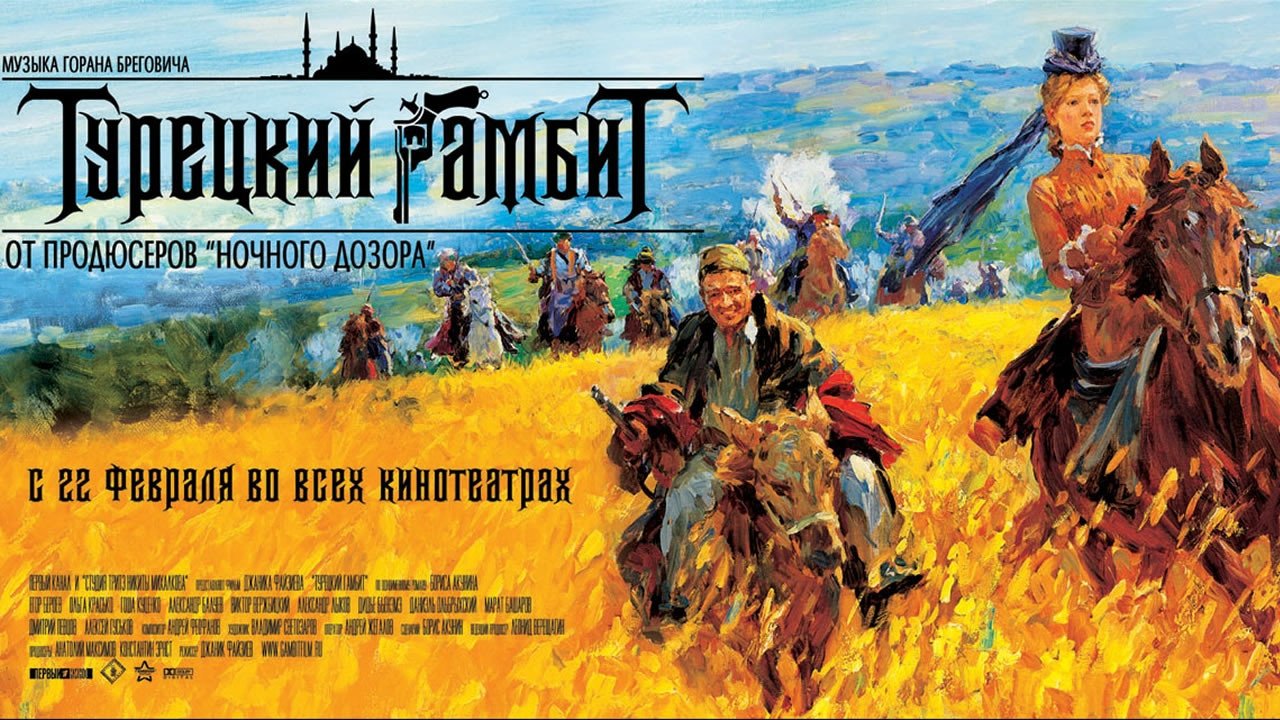
I really liked this poster. It reminded me of Frank Franzetta's work.
Following the lead of Brother Cordery over at Wargaming Miscellany, I ordered a copy of Turkish Gambit recently and watched it a few days ago. I ordered my copy of Amazon's German operation and picked the DVD up for approximately €10.
Both Mrs. Kinch and I are fans of Boris Akunin. He's a very talented Russian author who writes novels in a variety of genres, but most particularly mystery novels. His most successful series have been the Erast Fandorin novels set in the late 19th century and featuring the exploits of Russian state official Erast Fandorin who wanders around world righting wrong and investigating mysteries.
A story I have heard is that the novels were written in response to a bet that the author could not write a series of crime novels in each of the genres sub genre's. Thus, there is a Murder on the Orient Express novel, a Red Dragon type novel, etc. Turkish Gambit is Akunin's take on the Ian Fleming/Alistair Maclean heroic spy book.
The film is a relatively faithful adaption of the book, which is set during the Russo-Turkish of 1877. The Russian army is besieging Plevna when Fandorin learns that a secretive Turkish agent is sabotaging their efforts. He then tries to track down the enemy agent.
The film differs from the book in several respects, but the main points of the plot were there. The screenplay was adapted by the author and in terms of style and heft you probably won't notice them unless you know the book well. The cast put in a series of very presentable performances, though I think special mention should be made of Olga Kraska, who plays the female lead. I found her character insufferably irritating in the book, but Ms. Kraska managed to capture the irritation while still being a pleasure to watch and a fine comic actress to boot.
The production values were excellent and the director of photography certainly earned his money, though I would take note of the use of CGI. The use of CGI throughout is clever, immersive and imaginative - very well done. I would be very surprised if Guy Ritchie had not seen Turkish Gambit as his CGI sequences in the Sherlock Holmes movies are reminiscent of this film.
Turkish Gambit is a slick, funny adventure film and I would recommend it. You can buy it here.
of the most wonderful illustrators that has ever lived.
Treasure Island is a great book and like many great books, grew out of a small act. Stevenson's step-son was drawing one day and his step-father looking over his shoulder, saw that he was drawing a map. They spent the day naming the places and colouring it. And from the map came the book.
It is a simple story told by a boy on the cusp of manhood and therein lies its power. Jim Hawkins is a boy telling a story to other boys and his nature is reflected in the telling. There is no navel gazing or reflection in him, he doesn't agonize over killing or worry about the morality of taking buried treasure. Unlike his contemporaries in Victorian fiction, whose scruples often verge on the priggish, Jim's moral compass is personal, his loyalty to his mother and to his friends. His is a conscience rooted in the eighteenth century, his goals are clear and their simplicity and single mindedness drive the story forward.
Wyeth again - when I was a small boy, this image filled me with indescribable dread.
But even in this celebration of the 18th century love affair with laissez faire capitalism, Stephenson finds a place for evil. It is a grinning, grubby, chatty evil, far removed from the starkly painted moral monsters of children's fiction. Long John Silver is a murderer, a pirate and a scoundrel, but he is also charming, capable and a leader of men. Jim enjoys his company despite himself. Though Jim hates Silver for his cruelty, he admires him for his daring as all boys admire those who defy parental or scholastic authority with panache. In some ways there is little to choose between Long John and Jim, both pursue the treasure, Long John is simply willing to use brutal means to obtain it.
The Jim we meet at the beginning of the novel is a boy, bound to his mother and weighed down by childish things. By the end, he has encountered dangers, both moral and physical, and survived. He has mastered new skills and entered man's estate. For the rest of us, reading Treasure Island could be considered a vital part of that passage. You will find a particularly fine audiobook version of Treasure Island here. Note: This review was originally published elsewhere.
The last week has been gloriously and very pleasently busy. We had the pleasure of playing host to a visiting wargamer pal and his lovely wife. I dragged them both dragged around Dublin for a quick tour before returning home to Mrs. Kinch's cooking. Dinner and a game followed. There was also the intriguing possibility of more games by G+ or other video conferencing, so a success all round.
Maryville House Tearooms and B&B
(Mrs. Kinch for scale)
After playing host we waddled off to Belfast for a few days away and had a really lovely time. We were a bit confused as the city seemed utterly deserted on Monday, but we had forgotten that "The Twelfth" had been on the 12th and everyone seemed hungover and slightly bewildered. Though in a rebranding exercise that it possibly the greatest thing since usury became interest, the festival is now Belfast Orangefest. A bit odd to be sure, but a distinct improvement. So, we went to Belfast on Monday and basically it was shut. But we were happy to sit and read our books and generally relax - that to be honest was the plan anyway.
We stayed in the Maryville House Tearooms and B&B, which I recommend unreservedly. The food was excellent, the room wonderful and the staff uniformly lovely. To be honest, this was one constant of our trip to Belfast, with the exception of two ladies who were very trying (and were from Cork), the people in Belfast were friendly, helpful and couldn't have been nicer.
Dinner on Monday was French as befitted the occasion and it was really splendid. La Bastille on the Lisburn Road was top notch and we drank the health of the Swiss Guards and confusion to the Republicans in fine style.
Albert Memorial Clock
For anyone who likes Victorian and Edwardian architecture Belfast is a feast. My little Iphone camera simply wasn't up to capturing it in all its glory, but for what its worth - here is the Albert Memorial Clock. City Hall was a treat as well and well worth looking at. To be honest, you can't go very far in Belfast without seeing some really splendid architecture. The late Victorian stuff is a lot fancier than the often quite austere Georgian lines of my own home town. I don't pretend to know much about it, but it is certainly something to drink in.
Nelly cooling off.
Mrs. Kinch was very keen to go to Belfast Zoo. Now I was a little anxious about this, as Dubliners we have become used to going to Dublin Zoo and Dublin Zoo is world class. With the exception of Longleat Animal Park, it is probably the best place to go see animals that I've ever been. This does mean that on occasion, we have gone to zoos that didn't met that standard (Berlin Zoo springs to mind) particularly with regard to animal care. Happily Belfast Zoo was top notch and I would recommend it.
Two things we noticed while attending. Firstly, bring good shoes. The zoo is build on a hillside and there are quite a few steep slopes. Parents might want to consider bringing the sling and leaving the buggy at home. Secondly, most of the animals were asleep - Mrs. Kinch maintains that this was because of the hot weather, I know better. They were clearly recovering from the after effects of Orangefest. It's the only explanation that makes sense.
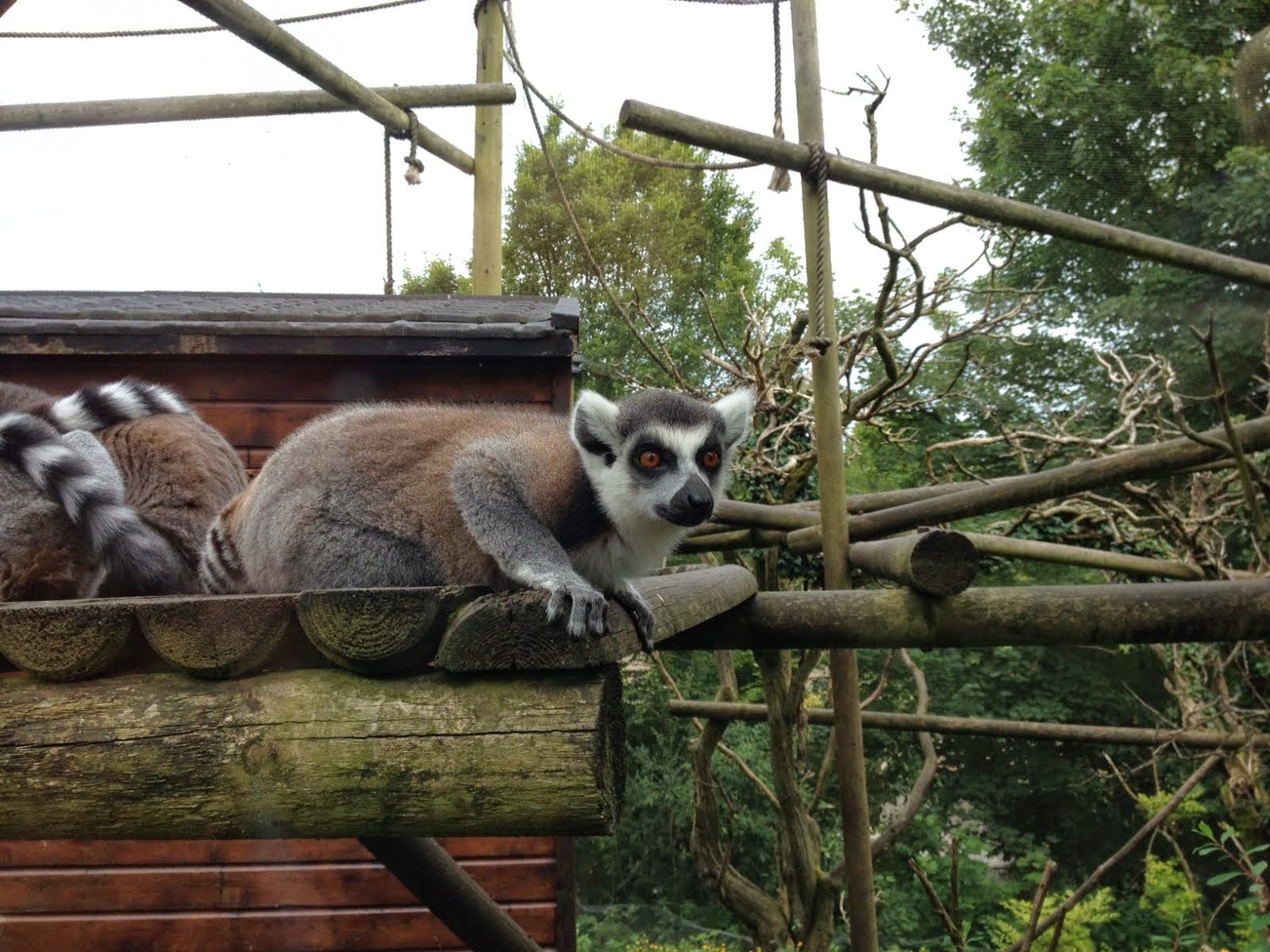
Ivan the lemur recovering from Orangefest
"Aspirin...Anne...for the love of God."
William and Ian the lemurs also recovering.
Cecil the Piglet had been marching with a drum for quite some time and was plum tuckered. (bowler hat out of shot)
Yvgenny the Meerkat on post
The Meerkats were quite lively - though I suspect that it because they are Orthodox and therefore did not attend the party.
Though while we were there, we did run into a get together for the The Miniatures Page Message Boards.
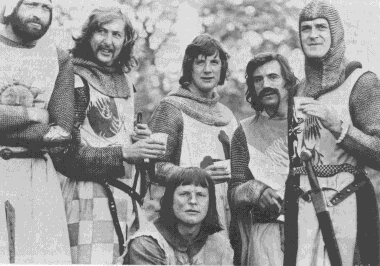
It was just as I remembered them.
Mrs. Kinch looking slightly miffed outside the Crown.
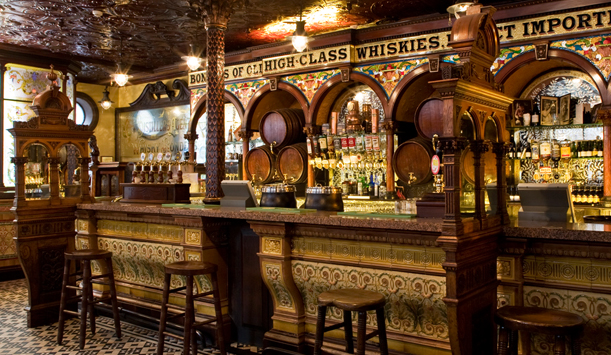
The Crown Liqour Saloon is a famous pub in Belfast that was refurbished in the 1880s. The job was done as a nixer by Italian workmen who were working on churches in the area at the time. It sumptuously appointed and the interior is wonderful.
Photo from Ireland.com
My Iphone camera wasn't really up to capturing the interior due to poor lighting, but as you can see from this shot of the interior - it is really something. Unfortunately, the sumptuous interior is pretty much where it ends. If you are going to Belfast and would be interested in seeing a particularly fine example of a late Victorian pub, the Crown should not be missed. However, the service was very poor, the drinks expensive and the selection not much better than one would get in the average boozer in Dublin. A bit of a one drink wonder. Go see it - but I wouldn't spend the night there.
Mrs Kinch outside The Aether & Echo, looking distinctly cheerier
In terms of pubs, The Aether & Echo, was our find of the trip. Best described as a "steampunk pub" it comes across as a bit poncy - it's website actually has a manifesto outlining the ethos of the pub - but don't be dissuaded, it is wonderful. A well appointed Victorian interior with plenty of snugs welcomes you as you enter. The bar staff were extremely friendly and I must say well turned out. Slightly more expensive that the average bar - but the quality of the service was superb and the drinks menu was very impressive. We visited there every day for three days and I didn't manage to try the same gin twice. Top notch. I only regret that we didn't eat there sooner as the food was superb. Two thumbs up - we will be returning.
The Titanic building
No trip to Belfast would be complete without a trip to the Titanic experience. This was Mrs. Kinch's idea and I'm very glad she talked me into it. The exhibition is very well laid out and covers a great deal of ground. The history of Belfast as a port, Harland and Wolf as shipbuilders, the construction of the ship and the tragedy itself. I found the last bit quite hard to watch - but it was impressive. Mrs. Kinch certainly enjoyed it and I would recommend it to anyone visiting Belfast. It's a little bit of a trek from the train station, so you might be better off getting the bus.
Though to be fair, probably one of the highlights of seeing the Titanic experience was listening to a couple discussing it while we left. One of them said, "I'm disappointed. I don't know what I expected. I thought there would be a boat."
Words failed me.
Speaking of transportation, if you are visiting Belfast, I would urge you to consider the visitor pass. It's £14 for a three day pass and allows you unlimited travel on buses and trains within the city. It also carries with it a number of discounts, so remember to look at the list written on the back and present it when you are buying your ticket. By making use of the discounts at the Titanic and the Zoo, we made back almost half the cost of the two passes that we bought - so it is worth bearing in mind.
Required reading so far as Kinch is concerned
Once we were done at the Titanic, we returned to the Aether & Echo for some excellent food and to explore more of their excellent drinks menu. I particularly recommend the No. 47 Monkey gin (both dry and sloe), the Paloma, the New York Sour and the Alhambra Club Cocktail.
The loot
Now, no trip to foreign parts would complete without dropping in on a second hand bookshop. The Internet means that new books in English are pretty much available anywhere, but second hand bookshops still have their charm. We paid a call to the rather excellent Keats & Chapman and emerged with heavier bags and lighter wallets.
My share of the loot was a proof copy of a Byron Farwell that I had not encountered before, a book on Zulu Kings (always good for a laugh and generally makes the Wars of the Roses look like a school picnic), Memoirs of a British Agent by Lockhart (which I'd heard of, but never read), The Massacre of Glencoe by John Buchan (bought purely for his name, I've no idea what this was) and a relative rarity, a enlisted Sepoys account of life in the Indian army.
On the whole, an excellent trip and we will be returning. Recommended.


.jpg)