Thursday, September 18, 2008

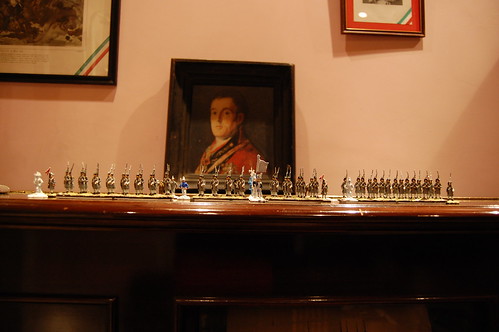
A taste of Ruritania for Tradgardmastare.

Huntzmanberg, a castle on the border between
Ruritania and the Hapsburg domains.
Note the Swartzkrag mountains in the blackground.
Aquatint by Mikail Patrickson 1836.


Ruritanian Government

Ruritania was once described by Count Metternich, during the Council of Vienna in 1815, as "…a model of good government, the pinnacle of enlightened absolutism and an ornament to the world". Though briefly a republic after French invasion, the idea was so unpopular that the populace revolted in support of their King with "God and King Michael and Death to the French!" as their rallying cry. Imposed from without, the short lived Republic of Hentzau stood little chance and soured the Ruritanians on the idea for a generation. Many radicals have bitterly regretted their collaboration with the French, arguing that "…eighteen months of French bayonets accomplished what hundreds of years of despotic misrule could not; a popular Elphberg."

Ruritania is ruled by a hereditary monarch and the reigning House of Elphberg was established in 1453, after a ten year long series of internecine conflicts known as "The Wars of the Cups". Rudolph Elphberg, later Rudolph the First of Ruritania (also Red Rudolph), smashed the army of his rival Constantine Brunchkli, at the decisive battle of Swartzkrag. Thereafter he marched on Streslau where he was eventually crowned King by the Arch-Bishop of that city. At the time, it was an event of such importance that the Holy Roman Emperor was in attendance.

While the hostility between Austria and Ruritania is a product of many factors, mainly geographical. It is said that the historic antipathy between the two dates from an incident at the coronation. As the newly crowned King was processing down the nave of the Cathedral, the Emperor stepped on the hem of his train, tearing it. The King famously set his dog (traditionally a Tekkel, though there is great debate on this point) on the Emperor with the words, "Small, though I may be (he was noted for his slightness), but I'll not suffer a fat man to tear something from me, but that he'll feel my teeth." The Elphbergs, have with a few interruptions, ruled ever since.

Immediately beneath the King is the Assembly, which is made up of two parts, the Cabinet of Roses and the Diet. The Cabinet of Roses, which is so named because it meets in the Rose garden of the Palace at Streslau, is appointed by the King, while the Diet is made up of all those men over 21 who hold patents of nobility.

While the King is in theory, an absolute monarch anointed by God Almighty to rule Ruritania as he sees fit, a great deal of power rests with the cabinet. While the cabinet cannot actually overrule the King, it is virtually unheard of for a King to go against the advice of the Roses, if they are in complete agreement. The Roses are generally at their most powerful at the beginning of a King's reign, their influence waning as he reaches maturity as a monarch and then waxing again as he becomes older and less capable. These periods of power are known as "first bloom, the falling of the petals and the second bloom".

The Roses are made up of:

- The Chancellor for the Treasury

- The Marshall of the Army

- The First Lord of the Privy Chamber.

- The Second Lord of the Privy Chamber.

- Secretary of the Privy Chamber.

- The King's Confessor.

- The Cardinal

- The King's Master of Music

Additional members may be added, but the Roses rarely exceeds ten and has never exceeded twelve members. With the exception of the Cardinal, the King's Confressor and the Master of Music, all the Roses must be eligible for entry in the Diet, that is, must hold patents of nobility.

The only other exception to this rule is the Marshall of the Army, who has twice, once in 1742 and again in 1780, been a commoner.

The Chancellor of the Treasury is probably the most powerful position, controlling as he does the Kingdom's finances, as well as being responsible for public buildings, tax collection, sewerage and roads. He is a man of many secretaries.

The First and Second Lord of the Privy Chamber are the two senior members of the Diet, the Dukes of Hentzau and Zenda, respectively. It is not unusual for these men to be amongst the first and most able nobles of the land, so that they may act as a check on the reigning monarch, as neither man would see the King alienate a kingdom that he has substantial holdings in.

The Secretary of the Privy Chamber keeps the minutes of the Cabinet meetings and is usually a favourite of the King's as he may appoint whomsoever he wishes to the post. It is a highly sought after post.

The titles of the First and Second Lords and the Secretary refer to the previous Cabinet, known as the Privy Chamber which was incorporated into the Cabinet of Roses by King Rudolph II in 1690. King Rudolph felt the Chamber was exerting too much influence and wished to dilute it by appointing more members. A common tactic of the members of the Privy Chamber, was filibustering, deliberate time wasting that deeply irked the King and prevented any actual work being done. Rudolph retaliated by relocating the Cabinet from the Privy Chamber to the Rose Garden of the Palace in Streslau where members were required to sit, regardless of the weather, until the King has dismissed them.

After a particularly rainy summer, two Lords of the Privy Chamber were carried off by chills, and Ludwig achieved the more congenial Cabinet he was after.

While both the Royal Confessor and the Cardinal-Protector are members of the Roses, by courtesy it is traditional that only one be present at any particular meeting. Experienced courtiers use their presence or absence to gauge the King's attitude towards Rome and indirectly towards Austria. It is thought that the Confessor, being a Ruritanian, will be more sympathetic to the King, while the Cardinal, who is an outsider, will inevitably try to talk the King out of hostile acts against the old enemy. Since the reign of Christian III ("The Wise"), who was taught in his youth by a Spanish Jesuit, Carlo Mario Martini, the King's Confessor has always been of the that order, which has sometimes excited to the disaprobation of Rome.

The Master of the Music is the only member of the Cabinet required to be a commoner. Music has always been considered the foremost of the Arts in Ruritania and the Master of Music is simply the King's favourite composer or musician. Much like the King's Fool in medieval times, the Master of Music is granted great licence to speak candidly to the King. As such, he is considered to be the voice of the common people and is often approached to present petitions to the King.

The Diet is a mere appendix, the King is not required to call it and usually only does so once a year, when all are present in Streslau for the celebration of Easter. The Diet votes to approve laws and taxs, though the King is not bound by their decision. However, it is an unwise monarch that angers the Diet, and while there is always tension between the Palace and the Hall (the Diet meets in the Hall of St. Stephen in Streslau), relations are usually kept civil. The only powers that the Diet has that are denied to the King are the powers to issue patents of nobility or to reassign the titles or lands of the Diet without its consent.

Monday, September 15, 2008

Names.

Saint Peter denies Christ.
Etching by Gustav Dore.


I spent a very pleasant weekend mainly in the company of my wife. Mrs. Kinch is back in employment again, after a quietness in the theatrical line, and blessed be the day. Mrs. Kinch is a great deal more tractable when she has an occupation. Not much painting was done over the weekend, but I did make a decent fist of the remainder of my first Charge! regiment. All bar the Chef de Brigade are finished. Considering how fond I am of the mounted arm, you would think that I would enjoy painting horses, but sadly it is not so.

I've been doing my first piece of writing for a span and finally had the break that I needed on Saturday. Send out for the shopping, I dawdled for half an hour on my way back reading Kipling online in a cyber cafe and trying to eavesdrop on the Indian proprietor. I think I am beginning to get a whiff of English as it is spoken on the sub-continent. There seem to be a lot of short sentences, but long multi-syllabic words. Hearing an Irish policeman hailed by an Indian businessman with, "Ah Pascal, what is the story"* in the tones of Dublin by way of Bombay says more about the changes in Irish society in the last ten years than any amount of news print.
Still I got what I needed and the first draft is done. I'll put it up here when it's done.

While I was writing the story, I came across some notes for Ruritania. I've been neglecting Ruritania. I should do some more work on it or at least type up those notes. I've been thinking about changing the name. When I was writing it at first Ruritania was a useful handle, but I think its begun to outgrow it. I have a very strong idea of who the Ruritanians are, a proud, churchy, musical people; poor but respectable, parochial, but not overly chauvinistic.

Keonig und Kirk und Kinder. The K and K and K of Ruritanian life, King, Church and Family. It probably doesn't work in German, but I know what I mean.

Georgia was on my mind, so I thought about renaming Ruritania after a Saint.

Pretoria has a nice ring to it, but it has unpleasant associations. I always hear it in the voice of Rhodesian friend of mine, the purring R and the soft T of his not quite English, not quite South African accent. He was a Rhodesian; he was NOT from Zimbabwe. Despite his support for an appalling regime, he was by most measures a sterling fellow and an excellent dinner companion. He came to Ireland immediately after the end of the Smith government and worked as a hydrologist. I always imagined him dying here and being buried in a lonely way, like the White Russians in the Non Catholic cemetary in Rome, but he moved to South Africa last year. However much he said he hated majority rule, I think he missed Africa more.

What other Saints are an option? Boniface? Hippolytus? Michael?

It's got to sound good with -ania, -ovia or a similar suffix.


*(Aahh PAS-cal WHAT izz the STOR-ey)

Tuesday, September 9, 2008

A regiment in the style of Charge!

The Regiment (name to follow) in line of battle.
Click to enlarge.


I mustered my first regiment according to the regulations laid down by Lawford & Young last night. Much remains to be done, but they made a fine sight even partially assembled.

The authors mark the pioneers and vivandieres as being optional, but to be honest leaving them out would mar the pleasant sensation of completeness that watching them march along, with all the panoply of a regiment on the road, brings.

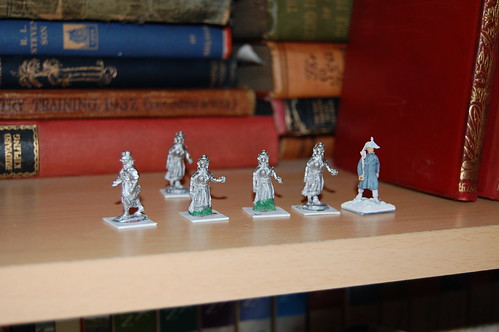
Recruits for the as-yet-unnamed-regiment. Left to right.
Top hatted chap in greatcoat. A selection of Les Filles de la Regiments. Two of these figures broke at the ankles in transit, so I gave them long skirts with greenstuff. Lastly a converted pioneer.
Click to enlarge.


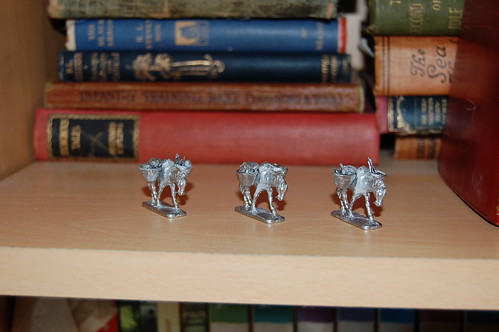
Pack animals and vivandiere's were purchased from Uwe Ehmke and they've arrived.

The pack that I bought from Uwe had a chap in a top hat and a long coat, that I actually think might make a better vivandiere than the lady also included in the pack, so I'll see if I can't turn him into a lady with a judicious paint conversion.

Who would really see a female figure underneath that great coat anyway?

The ladies will be painted up in the rather more drab garb of peasent women.

Uwe's figures are very pleasant castings, hand poured with the flash that that brings, but very serviceable for all that. I reserve judgement until I've actually painted them.

You can find Uwe's figures here or if you'd like to communicate with the chap himself, drop me a line and I'll put him in touch with you.


Shavetails of the Regiment. Figures by Uwe Ehmke.
Click to enlarge.


Vital parts of the regiment remain unpainted of course, but I'm almost there. Since all the rank and file are marching, I decided that all the other personnel would have to fit in with that look, so out went the sword waving officers from HAT's Greatcoated French Infantry 1805 to be replaced with the marching officer from their French Infantry 1808-1812.

The pioneers I put together by swapping the head of an officer from Greatcoated French Infantry 1805 on the body of a marching Young Guard from the HAT set of the same name. Add an axe from Italeri's Medieval Tournament set et viola; you have a gallant smasher of barricades and builder of scaling ladders.

In retrospect, for the look of thing (the RSM and the Ensign that I have both sport bearskins), I should probably have used a bearded head with a bearskin, but I'll know for next time.

I'm sure there are historical problems with the regiment, in terms of colour of epaulettes and so forth, but I find reading Charge! is a delightful antidote to that sort of thing. I might delve a little deeper into the matter in time, but I won't lose any sleep over it.

The commanding officer is a shako'ed chap from Italeri's French Imperial Staff with a head swap from a Prussian trooper in their Allied Staff set. I would have used an officer's head from the Greatcoated French, but it didn't seem to match, so I went hunting elsewhere for bicornes.

I've never been any good at conversions before, but since attempting my first few, the practice seems less intimidating and more rewarding then expending time and energy searching for exactly the right figure elsewhere.

Mrs. Kinch was at bell ringing and choir, so I had the whole evening to get the bit between my teeth and a very pleasant evening it was too*. Thank God things are beginning to settle down at last.

*I recommend Chesterton and Conrad as painting and converting companions of the first water.

Friday, September 5, 2008

Aunty dearest, may I have a medal?


One should never let such a boring thing
as active service lead to slackness in one's cravat.


{an old post from my old blog, but still worth a laugh I think}

I came across this the other day and it was too funny not to share. Lord Dunkellin was on active service in Persia at the time this letter was written. One of his duties there was to send regular reports to his uncle, Lord Canning. When he had no military or diplomatic intelligence to offer, he wrote to his aunt instead.

Lord Dunkellin to Lady Canning (his aunt) on the 16th December, 1856.

"I dedicate this despatch to you, as nothing of any material importance has occurred since I wrote to Uncle. C. so I will not obtrude myself on his time. We are getting on very well tho' the excitement of fighting and the new location being over, we are rapidly relapsing into the monotony of camp life. I have got a very good tent thanks to the General who is the best natured old man in the world, and having more than one of his own, has lent me a jolly Bengal Hill tent. It is much more convenient being on shore than living on board ship, as I am in the middle of everything and can see & hear what is going on much better than if I were afloat, besides at any rate here I am fixed, & feeling certain of my wherabouts, whereas I might be shifted from ship to ship according to the vacillating fancy of the Admiral in a most unpleasent manner. I hear that the General has sent in a flourishing account of our march & capture of Bushire, & I am certain the Admiral has done the same. Many here, especially the young ones, are anxiously speculating on the chances of having a medal given for the business. If there be one granted from India do you choose the ribbon, and take care to let us have a pretty one that will look well on red & blue coats...I think a white rubbon with crimson edges** wd. be rather tasty...I am rather disappointed in our spoil, especially in the horses. There are only four or five worth looking at; I shall try and get one at the auction today... The loot in the way of dresses, cloths, carpets, etc. etc. is not particular... I will try and get something to bring back for your room. The arms are dirty and worthless. So I do not think there will be any amount of prize money."

** Sadly, no white and crimson were to be had, just clasps added to the India General service medal. Dashed bad luck if you ask me.

Wednesday, August 27, 2008

Rumours of my demise.


Strolling down the nave.

(Original caption from my good friend Icecream: "We were not allowed to take pictures during the service itself. The... Vicar, or whatever, made it quite clear that anyone who defiled the sanctity of the occasion with their incessant clicking and flashing would burn in the INFERNAL FIRE!! He can do that kind of thing, you know.")


It has been a quiet few months here at "Joy & Forgetfullness", but the stillness here has been matched with manic activity in what the boorish call real life.

The big news is that on the 20th of June my darling wife and I became Mr & Mrs. Kinch in a ceremony in St. Patrick's Cathedral, Dublin.

It was proudest and most joyous day of my life.


Mr & Mrs Kinch leaving St. Patrick's Cathedral through a sword arch provided by members of the John Buford Memorial Society & Gentlemen's Supper Club.

The arrangements were not without their troubles; we had arranged to hire an 18th century Guild Hall in which to have the reception, however, due to skullduggery on the part of the Guild Hall's management we were left without a venue with eight days to go.

We took it all very seriously as you can see.


The club tie in all its scarlet & gold glory.

One would have thought that this would be an insurmountable problem, but my uncle in law, an eccentric gentlemen who happened to have a Georgian townhouse about his person that he wasn't using that weekend and put it at our disposal.

His daughters served food, his sons tended the bar (and plumbed in an extra bathroom at two days notice), aunts cooked and the whole thing
worked.

The Wedding Cake made by Mrs. Kinch's own fair hand. Toy Soldiers by Prince August.

Wedding out of the way, we were off to England for our honeymoon, which was spend in Bath, Longleat and London. It was magnificent and if such a thing were possible, I think I came back an even more raging Anglophile then I went.

But enough of this shilly shallying! Where's the wargaming?

Well, it's been quiet between; getting married, going to weddings (counting our own, nine this years, phew!), trying to join the Gardai (the wheels turn slowly, ever so slowly) and get a book published (15 rejection letters and counting), have all been eating up my time.

There has been time for a little gaming & painting.

I've been playing Kriegspiel, which is a magnificent game. I'm using the Free Kriegpsiel & Generalship Game rules from Paddy Griffith's "Napoleonic Wargaming for Fun"*. I've run the a game of the Waterloo campaign once, which ended in a narrow French defeat outside of Brussels. This was run in the pub and I think throughout the whole evening I managed two pints and a great deal of running up and down stairs from player to player. Who says wargaming is bad for the waist line?

I'll put up a report about it shortly.

The second game, which is being conducted by email is in full swing, but it is also looking like it's going to be a narrow French defeat outside of Brussels. Both Wellington and Napoleon were hit in the first series of attacks, though Bonaparte is looking like he'll recover first, though he has lost his left arm poor chap.

Thus far the French player has always decided to hit Wellington first and the the British player has always tried to run away. If this happens a third time I may have investigate the game design.

I've also played a couple of games of Warhammer Historical's "Legends of the Old West", though we did use the "Alamo" big battles expansion** and Napoleonic troops. These were good fun, it was a change to play an honest to God toy soldier game with dice rolling and single figure removal and all that flapdoodle.

The game is quite Old School in approach, though I can't say I'm desperately fond of the points system. It manages to dodge the worst excesses of the other Warhammer games, how exactly I don't know, I can't really remember what was wrong with them. I played it and enjoyed it and that's enough for me.

The other good piece of wargaming news was that I managed to get a copy of "Charge!" from abebooks without having to pay a King's ransom. I can now see why this little book has inspired such loyalty from its readers. The rules may be a little complicated for my tastes, though I've yet to use them in anger, the writing more than makes up for them. The authors have created a small, but vivid world and painted it with a subtle palette that charms the reader.

Certainly wins the presentation copy of "With Clive in India" for most charming wargaming book I've ever had the pleasure of reading, outdoing even the breathless enthusiasm of Donald Featherstone.

There has been more painting, mostly 54mm Austrians and American Civil War types for a Little Wars game next Febuary, though I may put on a demonstration game at a convention in September in the interim. More 1/72 plastics have arrived (to Mrs. Kinch's dismay) to feed my hunger for Napoleonic troops in marching poses.

The fit took me to put together a regiment in the style of "Charge!", so I've converted some pioneers, ordered pack animals and vivandieres and will hopefully be able to put one in the field in the not too distant future.

It's a good life.


*Which for all that Paddy keeps running it down is a cracking book in my opinion.

**Though when they say big battles they mean about a company a side. Oh how we laughed.


Tuesday, April 15, 2008

Battle Reports and orders after the Battle of Noswego.

With period spelling by request.

General Du Gormand's Report of the Battle of Noswego.


General as ordered we remained in Noswego on the night of the 3rd of March at 05;00 hours on the morning of the 4th the British open the battle with a barrage from 2 batteries of cannon positioned on the south bank in the town of Noswego and the British Horse crossed the river in force using the fords west of the town this advance was supported by elements of colonial troops.

The Fords where defended by our 3 regiment's of Horse who once again managed to send the British from the field with Les Chasseurs a Cheval du Bretagne under the command of Col. Pierre Nardin being the heros of the engagement and capturing a British officer Col. Frazer who was second in command of British forces.

It was just before noon when the town could not be held due to British guns making the position unholdable so our infantry and guns withdrew to the heights above the town and inflicted heavy losses on the enemy one barrage hit the British general staff it is believed General Lord Ponsemby was killed.

Some set backs where incured latter in the day as the weather turned and heavy rain made the withdrawl of the guns impossible these where eventually captured by the British.

Total British strength in the area was 3 regiments of horse 2 batteries of cannon 3 regiments of light infantry and 7 regiments of foot it appears to be the main body of the British army.

General Du Gormand's Orders

These orders where sent to you and cian using the reply all to look like a mistake feeding false information to the enemy

French orders to the troops at Noswego

Col. Florian du Anhalt based on your last battle report it is my belief that with the reinforcemnts that have been marching through the pass in the last few days which should arrive at your position on the 5th-6th of March that you will have the forces and oportunity to deliver a crushing defeat to the British at Noswego although the loss of the guns is a set back but honour dicates that they be retrieved.
Based on your reports and the information provided by Col Frazer it is certain that the enemies moral is low and a quick attack could achieve a great victory for France.
The infantry and guns should occupy the high ground above the town and force the british to withdraw further into the town or advance either will pull their troops away from the ford where our main attack will be lanched against using both Horse light infantry and our native troops this force will then break into the British rear area and haras thier supply lines forcing them to halt their advance.

General Du Gormand's Actual Orders

General orders to the army at St Elizabeth are to prepare a defensive position around the town digging trenches constructing fortiifcations, Aslo to carry out patrols of the approaches searching for the native troops.

The troops at Noswego will withdraw along the road using the light horse which withdrew from the field in good order to as a rear guard the army is to withdraw to Ashkazi and prepare for a delaying action if the terrain is good for defending.


Col. Shaw's Report

From Colnel Shaw, Montemerency Pass
To General James Wolfe

General Wolfe,

Our first proper engagement with the French was a success. We have taken the bridge over the Noswego, driven the French from the field and captured the French guns! Unfortunately, this cost the lives of two of our finest officers: General Lord Ponsonby was killed from a distance by a French sharpshooter, and Col. Fraser of the Royal Scots was captured by the French while leading a cavalry assault against their rear flank.

We intend to press forward with all haste.

Remaining,
Col. Robert Shaw.


Followed by...

Now for my orders to the troops!

I'ld love to stay here for a bit and recoup, but we don't have the time. You mentioned that it will take a full day to get our affairs in order after the battle, so I'll take advantage of the wait by sending out scouts on horseback to see what lies ahead. They are to range as far forward as they possibly can in one day and night. I want the entire army to be ready to move out on the second morning after the battle, but my orders to them will depend on the scouts reports. Their marching order is to remain the same as the first one I sent you, with the exception of Morgans rangers. I'm not sure what to do with them, because I'm not actually sure what punishment would be appropriate for fleeing the field. The rangers I'm tempted to leave alone, but would a flogging be appropriate for Morgan himself? I don't know how these things work, considering they're pretty much mercenaries.

Also, how much powder and shot do I have for those French cannon? I presume they left what they had behind, but will I be able to use them for the rest of the campaign or will my supplies of ammunition not be able to stretch that far?

Umpire Response to Col. Shaw

Your scouts report that the way forward is open country, with the valley narrowing slightly as you move northwards. Your scouts have identified chimney smoke approximately 10 miles ahead. They have been hampered in their duties by a strong screen of French light cavalry.

Your cavalry are shaky in the extreme at present, though Colonel Charleton is doing is best to rally them. The general feeling appears to be one of resentment over having been placed under an officer of Foot and a understanding that Col. Frazer got his just deserts. They are in short, wet, sulky and complaining. It is unlikely that they are to be entirely depended upon in the next battle.

The French guns are of a different calibre to your own, so you cannot use your own ammunition. You have a small quantity of shot, 3 roundshot and a fair quantity of case for each gun.

What are your orders Sir?

Col. Shaw's Response

Very well.

Since we have crossed the Noswego, it is no longer as important that we move at great speed. I see no reason to push these already exhausted soldiers too hard, particularly the horse and those unfortunate rangers. Ponsonby drove those poor souls far too hard. We can afford to be slightly more leisurely. We will form up and march out tomorrow morning.

Since the majority of the enemy action to our front seems to be light cavalry, the advance guard will be comprised of a screen of heavy foot, who will clear the open country ahead and look for an appropriate camping ground while the more vulnerable units move forward.

Here is the marching order:

The advance guard will be entirely comprised of three units of Heavy Foot: 1/15th Foot (Amherst's), 1/17th Foot (Forbe's) and 1/22nd Foot (Whitmore's). I don't want them to take any risks: Gormand is a cruel and cunning General, and we don't want to give him too many opportunities to harry us as we advance along the pass. If they encounter any enemy resistance they are to dig in and send couriers back to us. Now that we've completed the mad dash for the bridge, slow and steady is to be the order of the day.

For the time being, our cavalry is only to be used for guard duties along the flanks. The Flank Guard will be composed of our light cavalry. Their role is to be a rapidly deployable reinforcement in the case of an enemy action. Under no circumstances do I want them to face enemy units on their own: their fighting spirit has taken too much of a hit to allow that. I hope we don't have to order them into a combat. I'd rather they get some time to think about what it means to be British, and to get their fighting spirit back up. After all, at Crecy we destroyed the French cavalry for hundreds of years. Let's not give them the chance to return the favour, eh boys?

The Rear Guard will be comprised of our Heavy cavalry, and two units of Light Foot: the 1/60th Light Foot (Royal Americans), and the Provisional Light Infantry Battalion. I am putting so many units on Rear Guard because while I don't expect any French attacks from behind, I do suspect that Gormand is fiendish enough to get Indians to harry us from the rear.

The Main Body shall, therefore, be the following:
2/1st Foot (Royal Scots)
1/28th Foot (Bragg's) - to be given light duties as reward for taking French cannon
1/35th Foot (Otways)
Captain FitzPatricks Rangers - to be given light duties
Both units of guns
The Supply Train - now with extra French guns

The French guns are to be placed in the supply train until we reach St. Elizabeth, where the roundshot will be useful for breaching their defences.

Also, since we've lost a few officers, I want the records searched for possible Officer material.

You all know your duties. The French have proven that they are both brave and skilled, but we have driven them back and taken their cannon. They have learned that we will not hesitate to bring the fight to them, no matter the cost. Now let's get out there and kill some Papists, for King and country.

Col. Shaw.

Tuesday, April 8, 2008


The Battle of Noswego, a fair and accurate depiction of the action drawn from details of Col. Shaw's dispatch. The Edinburgh Currant June 4th 1757.

Our (pseudo) FIW campaign rolls on and has thrown up a couple of interesting questions.

The last battle was a contested river crossing. It started out well for the British, who had managed to assemble over a two to one advantage in numbers.

It didn't end so brightly.

The American rangers who had been so badly cut up the day before, were used to scout the river at night and then to spearhead an attack across a ford. 30% odd casualties and no sleep for 48 hours will sap anyone's morale. I think Cian has seen "The Last of the Mohicans" a bit to often, so they refused to fight and quit the field.

The British infantry marched forward to pin the French at the bridge while the cavalry hammered across the ford to cut off the French line of retreat. The French cavalry charged them, then feigned flight and managed to the get the British cavalry to charge right under the guns ensconced in the town, which made hash of them. The survivors were then charged by the remaining French cavalry and wiped out, the British second in command being taken captive.

The French then started to pull out of the town onto the heights behind under pressure from the remorseless tide of redcoats streaming across the bridge. The sight of every English atop a horse, that wasn't being led away captive, streaming away from the town did little for their morale and the advance slowed.

This gave the French time to pull out of the town and re-establish their guns on the heights. As the redcoats dressed the line, a stray roundshot struck General Lord Ponsonby's aide, Captain Simpson, killing the poor man and driving a fragment of his scabbard into Lord Ponsonby's side.

The noble Lord recovered himself after a brief moment and began to give directions to the battalions drawing themselves up in expectation of a rush on the heights. A heavy rain had begun to fall, fouling the powder in the pans and rendering the use of firelocks a chancy business. It was decided that the French would have to be driven off with the bayonet.

Carried by several Grenadiers of the 17th, Lord Ponsonby was giving orders to that effect and that especial efforts were to be made to take the French cannon, when he was treacherously and deliberately targeted by the French gunners. A roundshot crushed his right arm and side completely and he fell mortally wounded.

His subordinate, Col. Shaw took command and lead a charge up the hill by the 17th, the 22nd and the 28th Regiments of Foot. Colonel Anhalt had ordered a general retreat at this point and those French regiments that could were withdrawing in good order. However, a desire by the French gunners of the Batterie Du Courcelle to do more execution lead them to tarry too long and they were were unable to move the guns in time because of the exceeding wetness of the ground.

The guns were taken by men of the 28th (Colonel Bragg's) Regiment of Foot, which along with approaching nightfall marked the end of the battle.

All in all, it was a good game with some real turns of fortune. Cian had said that his objective was the enemy guns and though it cost him dear, he did take them. Dave managed to extricate his force with only minimal casualties (one regiment of Light Horse and the Batterie du Courcelle).

The battle does leave me with some questions though.

- Cian has captured a battery of four French guns, which are probably low on ammunition, having been heavily engaged all day. How likely is it that British gunners could successfully use British ammunition in French guns?

Naturally of course, this depends of what sort of guns they are, but lacking any accurate information (I really should have made this a Napoleonic campaign, i.e. something I know) I've said that both sides are using six pounders.

- How badly is the Pyhrric nature of the victory going to affect the British army? The French army lost a battery which will harm its prestige, but otherwise accomplished miracles.

I actually think this is a battle where both sides can claim some sort of victory, odd that, I didn't really think those happened.

Ponsonby's dead, but he was a new commander and not one that the army were particularly attached to. His successor, Col. Shaw, is a regimental officer and better known, if not as skilled.

The French did not manage to discommode the British infantry, the backbone of the army, in any way. They, in the words of one observer, "Stomped forward like bayonet wielding terminators and took the guns.". Maybe I put too much stock in Wellington's experience, but having your cavalry mauled doesn't seem to have broken British armies in the past. Cian was also so dismissive of the Americans combat refusal, that I'm not sure its going to affect the army's morale much...cripple its ability to scout and leave it prey to marauding Indians, yes, but that's for another day.

Cian is currently trying to work out if he should have Captain Morgan (the Ranger leader) hung for cowardice or have some of them flogged. I've pointed out that both are illegal, but he's still mulling over it. I reckon if he does, it'll most likely lead to the dissolution of the unit and his other American auxiliaries and angry protests from Colonial governors.

Dave, the French player, in an act worthy of "Operation Mincemeat" "accidentally" sent Cian his orders while replying to my email.

The false orders stated that the French having interrogated Col. Frazer were preparing for a sudden and crushing counter attack, in the hope of forcing the British onto the defensive so as to buy time.

Dave's actual orders were for his forces to fall back to the defensible feature and to start digging in.

The ruse did not have the hoped for result as Cian, assuming it was a genuine mistake sent Dave an email informing him that he hadn't read the orders and was deleting the mail.

Shabby Nazi trick or legitimate ruse de geurre?

Who can say, though honesty as the best policy is working for Cian, who seems intent on driving north as quickly as possible.