Tuesday, April 15, 2008

Battle Reports and orders after the Battle of Noswego.

With period spelling by request.

General Du Gormand's Report of the Battle of Noswego.


General as ordered we remained in Noswego on the night of the 3rd of March at 05;00 hours on the morning of the 4th the British open the battle with a barrage from 2 batteries of cannon positioned on the south bank in the town of Noswego and the British Horse crossed the river in force using the fords west of the town this advance was supported by elements of colonial troops.

The Fords where defended by our 3 regiment's of Horse who once again managed to send the British from the field with Les Chasseurs a Cheval du Bretagne under the command of Col. Pierre Nardin being the heros of the engagement and capturing a British officer Col. Frazer who was second in command of British forces.

It was just before noon when the town could not be held due to British guns making the position unholdable so our infantry and guns withdrew to the heights above the town and inflicted heavy losses on the enemy one barrage hit the British general staff it is believed General Lord Ponsemby was killed.

Some set backs where incured latter in the day as the weather turned and heavy rain made the withdrawl of the guns impossible these where eventually captured by the British.

Total British strength in the area was 3 regiments of horse 2 batteries of cannon 3 regiments of light infantry and 7 regiments of foot it appears to be the main body of the British army.

General Du Gormand's Orders

These orders where sent to you and cian using the reply all to look like a mistake feeding false information to the enemy

French orders to the troops at Noswego

Col. Florian du Anhalt based on your last battle report it is my belief that with the reinforcemnts that have been marching through the pass in the last few days which should arrive at your position on the 5th-6th of March that you will have the forces and oportunity to deliver a crushing defeat to the British at Noswego although the loss of the guns is a set back but honour dicates that they be retrieved.
Based on your reports and the information provided by Col Frazer it is certain that the enemies moral is low and a quick attack could achieve a great victory for France.
The infantry and guns should occupy the high ground above the town and force the british to withdraw further into the town or advance either will pull their troops away from the ford where our main attack will be lanched against using both Horse light infantry and our native troops this force will then break into the British rear area and haras thier supply lines forcing them to halt their advance.

General Du Gormand's Actual Orders

General orders to the army at St Elizabeth are to prepare a defensive position around the town digging trenches constructing fortiifcations, Aslo to carry out patrols of the approaches searching for the native troops.

The troops at Noswego will withdraw along the road using the light horse which withdrew from the field in good order to as a rear guard the army is to withdraw to Ashkazi and prepare for a delaying action if the terrain is good for defending.


Col. Shaw's Report

From Colnel Shaw, Montemerency Pass
To General James Wolfe

General Wolfe,

Our first proper engagement with the French was a success. We have taken the bridge over the Noswego, driven the French from the field and captured the French guns! Unfortunately, this cost the lives of two of our finest officers: General Lord Ponsonby was killed from a distance by a French sharpshooter, and Col. Fraser of the Royal Scots was captured by the French while leading a cavalry assault against their rear flank.

We intend to press forward with all haste.

Remaining,
Col. Robert Shaw.


Followed by...

Now for my orders to the troops!

I'ld love to stay here for a bit and recoup, but we don't have the time. You mentioned that it will take a full day to get our affairs in order after the battle, so I'll take advantage of the wait by sending out scouts on horseback to see what lies ahead. They are to range as far forward as they possibly can in one day and night. I want the entire army to be ready to move out on the second morning after the battle, but my orders to them will depend on the scouts reports. Their marching order is to remain the same as the first one I sent you, with the exception of Morgans rangers. I'm not sure what to do with them, because I'm not actually sure what punishment would be appropriate for fleeing the field. The rangers I'm tempted to leave alone, but would a flogging be appropriate for Morgan himself? I don't know how these things work, considering they're pretty much mercenaries.

Also, how much powder and shot do I have for those French cannon? I presume they left what they had behind, but will I be able to use them for the rest of the campaign or will my supplies of ammunition not be able to stretch that far?

Umpire Response to Col. Shaw

Your scouts report that the way forward is open country, with the valley narrowing slightly as you move northwards. Your scouts have identified chimney smoke approximately 10 miles ahead. They have been hampered in their duties by a strong screen of French light cavalry.

Your cavalry are shaky in the extreme at present, though Colonel Charleton is doing is best to rally them. The general feeling appears to be one of resentment over having been placed under an officer of Foot and a understanding that Col. Frazer got his just deserts. They are in short, wet, sulky and complaining. It is unlikely that they are to be entirely depended upon in the next battle.

The French guns are of a different calibre to your own, so you cannot use your own ammunition. You have a small quantity of shot, 3 roundshot and a fair quantity of case for each gun.

What are your orders Sir?

Col. Shaw's Response

Very well.

Since we have crossed the Noswego, it is no longer as important that we move at great speed. I see no reason to push these already exhausted soldiers too hard, particularly the horse and those unfortunate rangers. Ponsonby drove those poor souls far too hard. We can afford to be slightly more leisurely. We will form up and march out tomorrow morning.

Since the majority of the enemy action to our front seems to be light cavalry, the advance guard will be comprised of a screen of heavy foot, who will clear the open country ahead and look for an appropriate camping ground while the more vulnerable units move forward.

Here is the marching order:

The advance guard will be entirely comprised of three units of Heavy Foot: 1/15th Foot (Amherst's), 1/17th Foot (Forbe's) and 1/22nd Foot (Whitmore's). I don't want them to take any risks: Gormand is a cruel and cunning General, and we don't want to give him too many opportunities to harry us as we advance along the pass. If they encounter any enemy resistance they are to dig in and send couriers back to us. Now that we've completed the mad dash for the bridge, slow and steady is to be the order of the day.

For the time being, our cavalry is only to be used for guard duties along the flanks. The Flank Guard will be composed of our light cavalry. Their role is to be a rapidly deployable reinforcement in the case of an enemy action. Under no circumstances do I want them to face enemy units on their own: their fighting spirit has taken too much of a hit to allow that. I hope we don't have to order them into a combat. I'd rather they get some time to think about what it means to be British, and to get their fighting spirit back up. After all, at Crecy we destroyed the French cavalry for hundreds of years. Let's not give them the chance to return the favour, eh boys?

The Rear Guard will be comprised of our Heavy cavalry, and two units of Light Foot: the 1/60th Light Foot (Royal Americans), and the Provisional Light Infantry Battalion. I am putting so many units on Rear Guard because while I don't expect any French attacks from behind, I do suspect that Gormand is fiendish enough to get Indians to harry us from the rear.

The Main Body shall, therefore, be the following:
2/1st Foot (Royal Scots)
1/28th Foot (Bragg's) - to be given light duties as reward for taking French cannon
1/35th Foot (Otways)
Captain FitzPatricks Rangers - to be given light duties
Both units of guns
The Supply Train - now with extra French guns

The French guns are to be placed in the supply train until we reach St. Elizabeth, where the roundshot will be useful for breaching their defences.

Also, since we've lost a few officers, I want the records searched for possible Officer material.

You all know your duties. The French have proven that they are both brave and skilled, but we have driven them back and taken their cannon. They have learned that we will not hesitate to bring the fight to them, no matter the cost. Now let's get out there and kill some Papists, for King and country.

Col. Shaw.

Tuesday, April 8, 2008


The Battle of Noswego, a fair and accurate depiction of the action drawn from details of Col. Shaw's dispatch. The Edinburgh Currant June 4th 1757.

Our (pseudo) FIW campaign rolls on and has thrown up a couple of interesting questions.

The last battle was a contested river crossing. It started out well for the British, who had managed to assemble over a two to one advantage in numbers.

It didn't end so brightly.

The American rangers who had been so badly cut up the day before, were used to scout the river at night and then to spearhead an attack across a ford. 30% odd casualties and no sleep for 48 hours will sap anyone's morale. I think Cian has seen "The Last of the Mohicans" a bit to often, so they refused to fight and quit the field.

The British infantry marched forward to pin the French at the bridge while the cavalry hammered across the ford to cut off the French line of retreat. The French cavalry charged them, then feigned flight and managed to the get the British cavalry to charge right under the guns ensconced in the town, which made hash of them. The survivors were then charged by the remaining French cavalry and wiped out, the British second in command being taken captive.

The French then started to pull out of the town onto the heights behind under pressure from the remorseless tide of redcoats streaming across the bridge. The sight of every English atop a horse, that wasn't being led away captive, streaming away from the town did little for their morale and the advance slowed.

This gave the French time to pull out of the town and re-establish their guns on the heights. As the redcoats dressed the line, a stray roundshot struck General Lord Ponsonby's aide, Captain Simpson, killing the poor man and driving a fragment of his scabbard into Lord Ponsonby's side.

The noble Lord recovered himself after a brief moment and began to give directions to the battalions drawing themselves up in expectation of a rush on the heights. A heavy rain had begun to fall, fouling the powder in the pans and rendering the use of firelocks a chancy business. It was decided that the French would have to be driven off with the bayonet.

Carried by several Grenadiers of the 17th, Lord Ponsonby was giving orders to that effect and that especial efforts were to be made to take the French cannon, when he was treacherously and deliberately targeted by the French gunners. A roundshot crushed his right arm and side completely and he fell mortally wounded.

His subordinate, Col. Shaw took command and lead a charge up the hill by the 17th, the 22nd and the 28th Regiments of Foot. Colonel Anhalt had ordered a general retreat at this point and those French regiments that could were withdrawing in good order. However, a desire by the French gunners of the Batterie Du Courcelle to do more execution lead them to tarry too long and they were were unable to move the guns in time because of the exceeding wetness of the ground.

The guns were taken by men of the 28th (Colonel Bragg's) Regiment of Foot, which along with approaching nightfall marked the end of the battle.

All in all, it was a good game with some real turns of fortune. Cian had said that his objective was the enemy guns and though it cost him dear, he did take them. Dave managed to extricate his force with only minimal casualties (one regiment of Light Horse and the Batterie du Courcelle).

The battle does leave me with some questions though.

- Cian has captured a battery of four French guns, which are probably low on ammunition, having been heavily engaged all day. How likely is it that British gunners could successfully use British ammunition in French guns?

Naturally of course, this depends of what sort of guns they are, but lacking any accurate information (I really should have made this a Napoleonic campaign, i.e. something I know) I've said that both sides are using six pounders.

- How badly is the Pyhrric nature of the victory going to affect the British army? The French army lost a battery which will harm its prestige, but otherwise accomplished miracles.

I actually think this is a battle where both sides can claim some sort of victory, odd that, I didn't really think those happened.

Ponsonby's dead, but he was a new commander and not one that the army were particularly attached to. His successor, Col. Shaw, is a regimental officer and better known, if not as skilled.

The French did not manage to discommode the British infantry, the backbone of the army, in any way. They, in the words of one observer, "Stomped forward like bayonet wielding terminators and took the guns.". Maybe I put too much stock in Wellington's experience, but having your cavalry mauled doesn't seem to have broken British armies in the past. Cian was also so dismissive of the Americans combat refusal, that I'm not sure its going to affect the army's morale much...cripple its ability to scout and leave it prey to marauding Indians, yes, but that's for another day.

Cian is currently trying to work out if he should have Captain Morgan (the Ranger leader) hung for cowardice or have some of them flogged. I've pointed out that both are illegal, but he's still mulling over it. I reckon if he does, it'll most likely lead to the dissolution of the unit and his other American auxiliaries and angry protests from Colonial governors.

Dave, the French player, in an act worthy of "Operation Mincemeat" "accidentally" sent Cian his orders while replying to my email.

The false orders stated that the French having interrogated Col. Frazer were preparing for a sudden and crushing counter attack, in the hope of forcing the British onto the defensive so as to buy time.

Dave's actual orders were for his forces to fall back to the defensible feature and to start digging in.

The ruse did not have the hoped for result as Cian, assuming it was a genuine mistake sent Dave an email informing him that he hadn't read the orders and was deleting the mail.

Shabby Nazi trick or legitimate ruse de geurre?

Who can say, though honesty as the best policy is working for Cian, who seems intent on driving north as quickly as possible.


Monday, March 24, 2008

Thoughts...

...the campaign is going reasonably well at present, both players enthusiasm, the key ingredient of any campaign, remains high.

Things I've learned so far.

- It is better to be certain then right as a Umpire. The players will fix on any sense of hesitation and start tying themselves in knots trying to work out what it means.

- Players will spend the first part of any free kriegspiel trying to feel out the system. Once they grasp the fact that the system is entirely Umpire driven and opaque, they stop trying to work the system and start issuing orders, which serves them much better.

- The quiz mechanic works but is time consuming for the Umpire. The players gain great satisfaction from it, because success is earned, rather than the result of a die roll. It's good, but should be used sparingly.

- Ration information, it is far easier to think of reasons why a player didn't get information than it is to explain away information that you've given him, that he shouldn't have.

- Players are much more cautious in campaign play than they are in regular play. Firstly there is the need to preserve troops to fight another day and secondly, players are loath to lose a named character.

How the campaign has progressed so far:

The French have concentrating their forces at the northern mouth of the pass in preparation for a decisive engagement. General Du Gourmand has concentrated his cavalry under a good commander, Col. Dornan and sent them south to harry and delay the advancing British. While Du Gourmand has made attempts to liaise with the local Indians, he hasn't achieved much in that respect as his envoy soon become embroiled in a battle.

General Lord Ponsonby has made his way straight up the pass, gingerly feeling his way forward with a mixture of light cavalry and infantry scouts. He ran into Du Gourmand first defensive line towards the end of the first day and made a precipitate assault upon it, in which he suffered badly.

General Du Gourmand's orders to Col. Du Anhalt were initially to retire before the British arrived, however, by the time Du Anhalt actually received these orders, it was too late. The severe drubbing handed out to the British has turned the French player's head. Instead of withdrawing in accordance with his original plan, he has decided to stand and fight.

This is not as crazy a proposition as it sounds, Du Gourmand is not aware the British scouted his positions the night after their defeat and located the second ford across the Noswego. His prisoner interrogations did not come to very much, so he doesn't really know the size of the British force facing him, though it doesn't take Napoleon to realise that the enemy's main force is, most likely, behind his advance guard.

Ponsonby has managed to concentrate his force in front of the Noswego, secure overwelming numbers and bring up his guns under cover of darkness and put them in good positions covering the bridge across the Noswego.

His stated plan is to pin the force in the village of Noswego with his guns and then force the fords, encircling the town and cutting off the French line of retreat.

The French plan is essentially a repeat of last time, wait for the British to cross the river and then shoot them. Du Gourmand has placed cavalry to cover the fords, but I don't think it'll be enough. I could understand this course of action, if he tried to reinforce the Noswego garrison (though only the troops are Askazi are within reach). He also hasn't attempted to scout the British force, contenting himself with looking for enemy scouts on his side of the river.

I think the British will be able to force the Noswego, at present, it's just a matter of how much Du Gourmand makes them pay.

Friday, March 21, 2008

Battle reports.


Rangers of Fitzpatrick's Company skirmishing with the French, prior to their charging the bridge across the Noswego.

The British
From Col. Frazer
To my Lord Ponsonby

Reached Noswego bridge to discover French engineers attempting to destroy same. Engaged and disrupted said activity. In the process, discovered heavy French musket and Gun presence at other side of bridge, with negligible casualties to the Rangers. In face of overwhelming firepower, falling night and heavy rainfall, no further attempts were made to take bridge. Supporting guns did not arrive in time to make advances on enemy position before nightfall. Now holding our side of bridge. French cavalry unit on this side of the Noswego engaged and defeated: stragglers fled back across the river on previously unknown ford. Now scouting for other such areas.


Frazer

The French

General Du Gourmand

At approximately 1600hours on the 3rd of March English troops made an attempt on the bridge Noswego a successful defence was mounted by our troops in the area.

We at present hold the Northern side of the bridge and the British have moved a large body of troops to the southern bank of the river.

This is clearly a large scale British attach demonstrated by large numbers of foot and horse and British guns have been sighted in the area.

It is my intention to harass a British crossing of the river which will most likely be tomorrow using the cavalry which arrived late yesterday evening to cover a withdraw towards Ashkazi.

Unfortunately we have determined that the bridge cannot be blown.

Also I must report an excellent cavalry charge by a squadron of the Les Chasseurs a Cheval du Bretagne under the command Capt. Mela which successfully routed a larger force of British Heavy cavalry the captain should be commended for his service to France.

Yours truly,

Col. Du Anhalt


Thursday, March 20, 2008

Orders given on the 3rd of March 1757


Orders from General Du Gourmand at his camp at St. Elizabeth 3rd of March 1757

(with responses).


To Col. Simone Dornan


We are to making preparations at once for the defence of Montmerency Pass you will be placed in charge of all his majesties horse as French forces in the area are currently ill organised you new command will be outlined below.

Les Gendarmes du la Chevalier du Nouvelle Aubern

Les Chassuers a Cheval du la Chevalier Dornan

Les Chasseurs a Cheval du Bretagne

As commander of our cavalry you will be the eyes and ears of the army you are to scout and harass the enemy keeping us at head quarters updated on English troop movements be careful with your scouting as your forces are needed for a successful defence of the pass. Also if you make contact with any of our local allies remind them that France rewards loyalty and their orders are to raid the English supply lines

Bon Chance mon ami

General Du Gourmand


To General Du Gourmand (arriving at 1900 3rd March 1757)

From Col. Simone Dornan


Having set out at first light to take command of our vedettes at the mouth of the pass, we marched south. I met a courier bringing news that those vedettes have made contact with the English and are falling back, placing them at disadvantage where they may. I send him with this message. I have spoken with an emissary from Chief Winnitou, but little came of it, as pressing on to bring the fight to the enemy was of more import. The English have arrived in force, I shall endeavour to hold them at the Noswego."


To General Du Gourmand (arriving at 2100 3rd March 1757)

From Col. Florian Du Anhalt


The English skirmishers approached my position at 1600 today. I cannot withdraw with honour at present, also the recent rains make the moving of guns difficult. I have prepared a holding action at the fords over the Noswego.


We shall hold them as best we can, if not reinforced, I shall fall back at night fall, sending the guns first, and then make a forced march north. I shall leave skirmishers to harass the English as they attempt to the ford the river.


My force is a small one and I shall endeavour to do my best with it, should we succeed the credit shall be ours, if we fail, it shall be remembered that we struggled against great odds.


To General Du Gourmand (arriving at 1500 3rd March 1757)

From Col. Eoin McSiskington


General,


Our engineers do not think that can significant damage can be done to the pass with the means available. Those troops given me shall be deployed as you wish, I shall also with your permission, begin the erection of earth works at the northern mouth of the pass. It is also my painful duty to report that Col. Jean-Baptiste de Gribeauval has expressed grave displeasure at being placed under my command and high words have been exchanged.


To General Du Gourmand (arriving at 1400 3rd March 1757)

From Col. Jean-Baptiste de Gribeauval


General,


I have been placed in the unsoldierly and insupportable position of having been placed under the command of an inferior. This is both unacceptable and a grave insult to the honour both of myself and the Regiment Cambis. That we should be so put upon by bushel of ignorant foreigners led by a Hibernian mercenary is shocking. Barring an information directly from you in the next few hours, I shall place myself in command of the force covering the northern mouth of the pass.


To Col. Florian du Anhalt


We are currently on the defensive around Montmerency pass you will be placed in command of our primary defence you force will consist of the following Le Reine Regiment Bearn Regiment Auvergne Regiment and the Batterie du Courcelle in total 3 regiments of foot and 1 battery of guns.

Some scouting of the heights should be conducted to find a way to withdraw should the pass be blown as the sappers under Col. Eoin McSiskington will be investigating if this is possible he will be in charge of the remaining forces defending the pass.

You should base you defence around the town of St Elizabeth and preparations for the defense should include digging of trenches for guns and infantry all local men of the town should be formed into a militia force and supply with excess muskets if possible.

Yours truly

General Du Gourmand


To Col. Eoin McSiskington


As you are aware we have been pushed back by English forces in this area our orders are to defend the Montmerency pass the following forces are to be placed under your command.

Cambis Regiment

Les Volontaires Etrange

Batterie du Chartrand

Compagnie de Mineurs Bricot

The Compagnie de Mineurs Bricot are to make preparations to see if the pass can be blown as soon as this is known you are to inform me if it is possible to blow the pass preparations are to be made to do so.

The rest of your force is to cover the northern area of the pass and support Col. Florian du Anhalt defence of it around St Elizabeth your troops are to use the local terrain for any advantage. If none is found to be suitable prepare trenches.

Yours truly,

General Du Gourmand


From General Lord Ponsonby, New Loudon

To General James Wolfe

General Wolfe,

Following our misadventure at the mouth of Mont Moucy Pass, my men are quite eager to beat the French from Montemerency! The blood of these fine English is quite a-boil with hatred for the toad-ish Gormand.

Seeing as Capt. FitzPatrick has a familiarity with the terrain we shall be taking, I am appointing Capt. Morgan and his rangers to lead the Advance Guard towards the Noswego. He shall be accompanied in this advance guard by the 2/1st Foot (Royal Scots), with all Advance units under the command of Col. Fraser and his brother, Nialls.

The orders of the Advance Guard are to scout rapidly ahead of the main army. I would prefer that these men will remain unseen by the enemy, but in the case of light enemy action, for example skirmishers or Indians, they are to engage. Should heavy resistance be encountered, they are to fall back with all haste.

The Flank Guard will be composed of our light cavalry: those of Kingston's Light Horse and Shaw's Light Horse. Their role is mainly to be that of scouts. Should the enemy approach from the flanks, I wish these units to gather what information they can and report back to the main body as quickly as possible. If necessary, they will also provide the function of a "flying" guard, advancing or retreating rapidly to provide reinforcement for the Advance or Rear Guard.

The Rear Guard will be comprised of our remaining light foot, the 1/60th Foot (Royal Americans), under the command of Col. Cox and the Provisional Light Infantry Battalion under the command of Capt. Luther. As with the flank guard, these men are to avoid confrontation where possible, and instead gather information to send forward to the Main Body and Flank Guard.

The Main Body shall, therefore, be the following:

Foot

1/15th Foot (Amherst's)

Foot

1/17th Foot (Forbe's)

Foot

1/22nd Foot (Whitmore's)

Foot

1/28th Foot (Bragg's)

Foot

1/35th Foot (Otway's)

Engineers

Col. John Henry Bastide's Coy

Heavy Horse

Charleton's Heavy Dragoons

Guns

Templeton's Battery

Guns

Turner's Battery

Supply Train

Supply Train

The orders of the Main Body are to advance towards the Noswega with utmost speed, and make safe the saddle beyond it. Hopefully, this will provide us with a large enough area, with watering hole, so that we can make camp for as few days as possible while Capt. FitzPatrick and his Rangers scout the area towards St. Elisabeth. The narrow approach to the town makes me nervous of French ambush, so as much care to know the intricacies of the territory will be taken as possible, while keeping a mind towards the need for haste.

While it is well known that the Indian savages are more than happy to side with either French or English, I personally put no trust in their information. It is not my intention to make any use of the brutes in the area. My men are under strict orders not to persecute the Indians in any way, but should they prove a barrier, then that barrier will be removed with all prejudice.

My main goal for this early leg of the action is to provide my men with a base in the Montemerency Pass from which we can operate: I believe the saddle area where the brutes occasionally make villages will the most suitable area. In order to reach this area, however, the Noswega will have to be crossed. I do not believe that the French will have left this area unguarded. As such, on the approach to the French bridge the Advance Guard will remain only a few short hours march ahead of the Main Body, so that the Guns may quickly be brought to bear in the case of enemy fortification.

In the case that the French have already destroyed the bridge, then the Engineers will have to build me a replacement. In preparation for this, I have made orders that the necessary amounts of hard timber (and any other items the Engineers might need) are to be bought in large quantities in New Loudon and brought with us in the supply train. I don't want the Engineers to have to gather resources from the area around them: I will not dally while my men are made to act as lumberjacks.

I remain,

General Lord Ponsonby, Mrs.


Response


Colonel Fraser is somewhat put out by the phrase in your orders "I am appointing Capt. Morgan and his rangers to lead the Advance Guard towards the Noswego." Captain Morgan is both his inferior in rank and a Colonial officer and Fraser has taken this as the gravest insult. Given that you cannot place a lower ranked officer over another, he has taken command of the Advance Guard and, chivying the Rangers ahead of him, has set out at a goodly pace. The Rangers do not seem to be taking this well.


General Lord Ponsonby's Response

As for Fraser, at the soonest possible opportunity I will have him brought to my tent for a severe dressing down. While I did say that Morgan and his men were to "lead the Advance Guard towards the Noswego", I also stated quite clearly that "all Advance units" are "under the command of Col. Fraser". The use of the word "lead" was only to indicate the physical positioning of the troops. Given that Fraser is both "Bold (may interpret orders loosely)" and "Arrogant and stiff-necked", Ponsonby will assume that his reaction was one of pique, and will recommend that in the future he should fully read his brief before acting in a manner that upsets the men.

He will also remind Fraser that he is being given a great opportunity here, and that his petulant behaviour may endanger future opportunities.

It has begun to rain, not heavily, but sufficent to impede the action of musketry. The rain is also softening the ground, making it difficult to move guns off the road.

Communications to General Ponsonby on the 3rd of March 1757.


1230 from Col. Frazer.

Skirmishing with French Chasseurs some three miles ahead of the main body. We have beaten them in, killing some, but no prisoners have been taken. They are falling back.

1400 from Col. Frazer

Have sighted Noswego. The French are present with guns, with Foot to the number of perhaps three regiments and some Horse. The civil population are fleeing. The bridge seems intact, but there appear to be engineers attempting to break it. We are not in sufficent force to prevent them. I most earnestly intreat that the army move up at best speed.

General Ponsonby's response

To Frazer:

Hold where you are. We are approaching at utmost speed. If threatened
by superior numbers, do not attempt to hold out. Withdraw, and let
them give chase.

Ponsonby"


Ponsonbys orders:

Flank Guard: advance and join Col. Fraser with the greatest speed, but
only to act as reinforcement in the case of enemy attack.

Main Body: Everyone on the road ahead of the guns is to get the hell
out of the way. The Guns and two units of Heavy Foot are to move as
fast as they can towards the Noswego. I want those boys within range
of the bridge as quickly as possible: since the French are destroying
the bridge, I'm presuming they won't have their troops on our side. As
such, I want the Guns to start dropping shells on them from this side
of the river as soon as possible.

The rest of the army is to make best haste to the bridge, and try to
remain as close behind the Guns as possible.

Rear Guard: advance to the Main Body and take over duties of Flank Guard

Monday, March 17, 2008

French Players Briefing

General Du Gourmand immediately after learning his strategic situation. Careful observers will notice that his hair has turned white.

From the pen of General Louis-Joseph de Montcalm-Gozon, Marquis de Saint-Veran in quarters at Louisbourg 1th of March 1757


To General Du Gourmand at his camp at St. Elizabeth.


General Du Gourmand,


Louisbourg is in great peril and I need not (nor could I, if I wished) conceal from you, a hardened campaigner, the extremity of our situation. The English have driven us back beyond the Allegheny mountains and are at present gathering their strength to push through the passes and on to Louisbourg. Our forces are few and their strength is considerable, therefore it is imperative that we have early warning of which passes they are attempting to traverse, that we may concentrate our forces against them.


You are instructed to take under your command those forces now present in the Montmerency Pass. You are to provide early warning of English movements, strengths and intentions, sending word by messenger as soon as they are sighted and providing a daily report of any contact that you have with them to me at Louisbourg.


In the event of an English attempt on the Montemerency pass, you are at all costs to hold the town of St. Elizabeth which commands the northern exit of the pass and harass, mystify and delay their advance by all those means at your disposal.


I remain,


General Louis-Joseph de Montcalm-Gozon, Marquis de Saint-Veran


You must:-


  1. Write orders for each of these bodies and any detachments. They should include.


  • instructions for each body.

  • Action to be taken on spotting the enemy.


Any body that you are with personally may of course act as you wish, but any body of troops not under your direct command will act in accordance with their orders and the character of their brigadier, until orders arrive to do otherwise.


2) Write any other orders regarding scouting, logistics, spies, bribing local Indians, burning buildings, building bridges, etc.


NOTE: I will not call you back for clarification regarding your written orders, if I feel the order is unclear or ambiguous and I will act in accordance with the Brigadiers character and what I believe he would be in the circumstances.


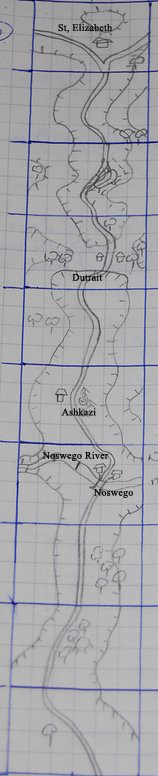
The Theatre of War


Wednesday, March 12, 2008

Lord Ponsonby's Briefing.


Lord Ponsonby, Commander of His Majesty's Forces in these parts;
also the very Olympian ideal of Manhood.


I thought it might be interesting to chart the course of our little campaign. With that in mind, I'll be putting the game materials, orders, etc up here as well as my own thoughts on how things are going.

For starters the British (the attacker) player's briefing.

From the pen of General James Wolfe in quarters at Rourke’s Landing 7th of March 1757


To General Lord Ponsonby at his camp at New Loudon


My Lord Ponsonby,

As you are aware our forces have moved sume distance into the country held by the French, but their energies are now spent and we shall have to spend some time in bringing up provender, horses, powder & shot, etc. In our advance we shall have to pass over the Allegheny mountains, no contemptable obstactle. There are several passes through the mountains that may be practicable. Columns are being detached to investigate those passes and see if they may suited to the transit of men and stores.

You are to take those forces under your command and to make best speed for the town of St. Elizabeth directly to the north of New Loudon at the end of Montemerency Pass no later than the 17th of this month. This pass had not been mapped by any of our officers, so we have but little idea of the country between, through we are advised that the French under General Le Gormand hold it in some strength.

Therefore you are to bring your forces as far up the pass as you may do, observing as you may. It is most important that you send back reports of the route daily and press on as far as possibility defeating those French forces that are present to the best of your capacity. If practicable, you are to take and hold the town of St. Elizabeth, which marks the end of the pass, that it may be used as a base for our advance into French territory.

If St. Elizabeth cannot be taken you are to make detailed sketches of its defences, an appraisal of the French forces present and what forces would be required to take it.

I remain,

General James Wolfe, Officer commanding his Majesty’s forces in the colonies.

Appreciation of the Montemerency Pass by Captain of Rangers, Michael Fitzpatrick.

The Montemerency Pass is a friendly passage through the Allegheny mountains, though exceeding narrow in places. The forest on either side being very thick and impassable to formed troops, though it is hospitable to Indians and Rangers.

It is cut by the Noswego river halfway along its body. The river, being fordable in summer, is viable to swell after sudden showers and care should betaken to pass over it by the grand stone bridge built across it by the French some years past. Some 10 miles beyond the village of Noswego, the saddle of the pass is to be found, where in summer months some Indians, friendly to the French, make their abode in rude huts and similar dwellings. Between the Noswego and the saddle, there is a fine water hole, at which travelers are often found. The pass beyond the saddle becomes more narrow, opening out only at the end, where the town of St. Elizabeth sits on a rise overlooking the exit.

Travellers voyaging through the pass should be aware that the Indian therein are for the most part in the pay of the French and are treacherous beyond the common run.

Player information.

You must:-


1) Break your army up into:

Advance Guard – Should be predominantly Horse or Light Infantry.

Flank Guard – Should be predominantly Horse or Light Infantry.

Main Body

Read Guard – Should be predominantly Horse or Light Infantry.


2) Write orders for each of these bodies and any detachments. They should include.


- instructions for each body.

- Action to be taken on spotting the enemy.


Any body that you are with personally may of course act as you wish, but any body of troops not under your direct command will act in accordance with their orders and the character of their brigadier, until orders arrive to do otherwise.


3) Write any other orders regarding scouting, logistics, spies, bribing local Indians, burning buildings, building bridges, etc.