Saturday, June 9, 2012

Muster British: Part Five

"Who could foresee thee, in a space so brief,
 A scene where mingling foes should boast and bleed."

There's precious little of the Byronic hero about this scene. A Strelets French surgeon (who having attended Trinity College is now in British service) and orderly, painted by the redoutable Mr E. I think the original figure was meant to be Baron Larrey, but in our Napoleonic roleplaying game he was Ensign Thomas Hanson, physician, soldier and reprobate. His assistant Toby was well known for his persistent lollygaggery and drunkeness.

The wounded men are a mixture of converted Strelets, Newline and Irregular miniatures.


The good friars are from a set by Imex, but I'll be damned if I can remember what it was called. They are very nice figures through.

The wagon train. I've made use of these, mainly in games of En Avant! by Jim Wallman, but no doubt I will find further uses for them.

An overview, mule train to the left, light wagons to the right. Heavy wagons to the left rear and food on the hoof to the right rear.


Italeri 60th Rifles (I think they were originally 95th) doing duty protecting some wagons, converted from excess French ambulances. I really like these figures and painted them myself. They were in fact the only 1/72 figures that I managed to paint while I was in college. I love the pose, it reminds me of my time in the reserve defending our great nation from the paramilitary wing of the Wicklow Ramblers Association. It really was the only comfortable away to hold an FN (that's an SLR for our brethren on the other side of the Irish Sea) for prolonged periods of time.

Pack mules from a variety of sources. Irregular 25mm, Uwe Emhke 20mm and couple bodged together from spares. These are being led by some Uwe Emhke figures and Imex pioneers.
Imex pioneers doing duty as camp followers, accompanied by beef and bacon on the hoof (or should that be on the trotter?)
...and finally, Italeri French wagons and Imex pioneers wagons.

And that concludes our muster of the British army. I did not anticipate this taking to long and will hopefully return you to something a little more interesting shortly.

Friday, June 8, 2012

It's oh so quiet


Gaming until 0300 will really take it out of a fellow


 It's been a very busy time and I've had precious little leisure to catch up with blogging.

- Mrs Kinch is poorly again, having done her back for a second time in two years. It looks like an operation is on the cards. This has put her in rather poor form. Her laptop also going for its tea has  not improved her humour.

- I have a number of battle reports and so forth to put up, but I may require a 25 hour day to get them suitably written up. Most recently Salamanca,Talavera and Maida.The Talavera and Maida evening was a good one as you can see above.

- I took delivery of some more goodies from Kristian and Uwe. There will be pictures I promise.


 Actual photographic evidence of Bob Cordery's recent visit to Dublin

 - By a bizarre coincidence, I ran into Bob Cordery (pictured) and his lovely wife (not) during what appeared to be a frustrating visit to Dublin. I hope I ameliorated it somewhat and the rest of the trip went well. We had a coffee and a chinwag which was very interesting.


- Posted using BlogPress from my iPhone

Thursday, May 31, 2012

Mustering the British Army: Part Four


The First Cacadores

These are Revell 95th Riflemen, given a lick of paint by Mark Bevis and transformed into "the fighting cocks of the army." The command figures are like my 60th Royal Americans, Italeri figures.


Another view of the Cacadores

Very sharp eyed readers will note that one unit is painted as Tiradors. These chaps have done good service, but I've failed to finish the basing on the last unit as well as losing a few to straggling. Definitely a rainy day project to fix that.
One of my numerous Spanish/Portuguese militia units

These boys are HAT Spanish guerrillas given a particularly generic uniform so that they could stand in for Spanish or Portuguese line infantry. I'm less satisfied with the fix than I was. The uniform isn't completely correct for any unit in particular. I'm scratching my head to remember when I got it from originally, I think one of the Ospreys on the Portuguese Army. I painted these myself, but I think I'll be doing some further research once I've added a few more units as the one size fits all solution is sitting less well with me.


My Luso-Hispanic Brigade

As I said above, the chaps in the front rank do duty as Spanish or Portuguese, but the lads in the rear are definitely part of my Spanish army. Led by the gallant General Romana, they will be taking the field in a series of purely Spanish battles once I get some Grenadiers.

The Regiment Del Rey

These are SHQ/Kennington figures painted by a cousin of Mrs Kinch. The First Regiment Del Rey is apparently the oldest military unit in the world. To qoute no less a source than wikipedia.

"There is certain proof of this and according to what the chronicles mention, King Ferdinand III, "The Saint," in 1248, during the conquest of Seville, with some of his men-at-arms, assaulted and took a tower. Seemingly, with such boldness and bravery they gained the admiration of the King. The campaign finished and with the consequent disbandment of troops, King Ferdinand decided to permanently keep with him said force, giving origin to the permanence of the Armies, that is to say, the origin of itself."

Suffice to say, I could not bring myself to gainsay such a claim and have cheered on the gallant Dons whenever they take the field. 

The Regiment Irlanda

These boys are close to my heart, painted by Mr E, a frequent visitor to the Kinch household and a much beloved fellow cigar smoker. These are Falcata figures and only recently rereleased. I recommend getting ones paws on them. I have prattled on at length about these boys here.


An overview of the artillery part

You'll notice that this shot is mainly dominated by HAT caissons. I haven't come across anyone that makes British caissons, so I decided that my British forces would have to make do with ones captured from the French. They look well don't they?

I'm not entirely sure where my obsession with collecting tail units and logistical support came from - pseudo-psychological explanations in the comments section please.


My only RHA limber

I love the RHA, I think the uniform is especially smart and I find the idea of hurtling around the countryside dragging a crazed beast of a gun behind you to be a thrilling one. The gun pictured is a Hinton Hunt nine pounder I think. I don't deploy guns with a full team anymore, but even so it makes me happy just to look at it. The joy of the thing is the thing itself. I have some RHA crew, the kind gift of an American friend, which will be joining this lot very shortly.

RHA in the field

These chaps are Newline Designs RHA crew and gun with a suitably converted Light Dragoon as a mounted officer. I was finding it difficult to fit entire gun teams into a five inch hex, so in a rare concession to practicality, I decided that I would represent Horse Artillery by the addition of a mounted officer rather than a mounted team.


The Old Corps

My oldest British artillery, which I made up and painted myself, from the now defunct Revell British Foot Artillery set. These fellows have seen some service with the more modern Newlines, most notably during a brief campaign played using the Games Workshop Legend of the Old West Alamo rules. They were part of the garrison of Craggy Island off the west coast of Ireland. They blew a mounted charge of French dragoons all to blazes during the French attempt to stirr revolution in the country in 1796 by making off with the Holy Stone of Clonrichert. It must be remembered that at the time, the stone was but a lowly class three relic, rather than the glorious class two it is today.

Another shot of the Artillery park


A Strelets officer pausing to have a conversation, 
I suspect about fishing, with the chaplain.

Beyond knowing that there were few chaplains with Wellington's army I know very little about spiritual affairs in the Pensinsula. I know Gleig of "The Subaltern" fame (of which I hold a much treasured 1854 edition) became a clergyman in later life as did William Hamilton Maxwell, whose "Wild Sports of the West" is a brilliant description of pre-Famine Ireland as well as being screamingly funny.

And as the catalogue staggers on, it appears there will be a part five.


Tuesday, May 29, 2012

His Serene Highness the Duke of Brunswick


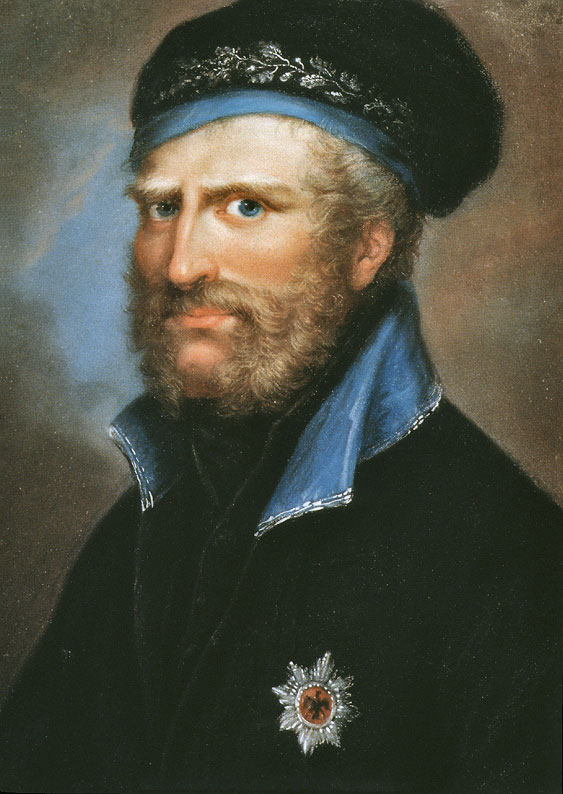
Frederick William, Duke of Brunswick-Wolfenbüttel 
by Johann Christian August Schwartz (1809)


The Duke of Brunswick cuts a somewhat eccentric figure. He ruled the Duchy of Brunswick-Wolfenbüttel which was a patchwork of lands, much like most of Germany in the eighteenth century. His father, Charles William Ferdinand, a man of considerable military experience in the Prussian service, had raised the standard against the Republican government of France and missed a vital opportunity to crush in its cradle at Valmy.

Frederick William, the Duke pictured above, was one of Frances bitterest enemies during the Revolutionary and Napoleonic. After the battle of Jena, in which his father was killed, his home was made part of France and become part of the Kingdom of Westphalia. When the War of the Fifth Coalition broke out in 1809, he raised a corps of light troops (his father was acknowledged as an experienced leader of light infantry) in the Austrian service. He managed to liberate Brunswick briefly, but was forced to withdraw to England, where he and his men joined the British service.


Frederick William, Duke of Brunswick-Wolfenbüttel 
by Art Minaturen & Krisztian

They did however unlike many foreign corps (i.e. the Chasseurs Britanniques) keep their own uniforms; all in black in mourning for their homeland. They also wore skulls on their hats, without being the baddies. They served,  despite a habit of desertion, creditably in the Peninsula, including at Salamanca, the Pyrenees and Orthez.


Much like Claude Rains in Casablanca*, the romantic in me is attracted to the Brunswickers. Though the corps was marred by its spotty record of desertion, which was mostly a result of recruiting of prisoners of war when they were in the field, there is something deeply personal about their struggle with the French. It reminds me of General Thomas Graham, who only took up arms against the Republic after their soldiers had broken open his wifes coffin and interfered with her.  


The Duke & a horses ass

Brunswick was liberated by the Prussians in 1813, but the Duke did not live to appreciate his return home for very long. When Bonaparte escaped from Elba, he took up the sword again and led a small division of troops to join the Anglo-Dutch army that was to face the French at Waterloo. Sadly, he was slain at Quatre Bras, being killed by a musket while leading a charge. 

Curiously enough, the title lives on in an unusual way - in The Duke of Brunswick vrs Hamer 1849. This is a ruling in the English Law courts (and which has been used for precedent in Ireland) that each instance of a libel constitutes a seperate offence and that a non-resident may sue for libel in Britain. There is reason to believe that this law may be overturned in the near future.

*A shiny sixpence says Stokes knows the line I'm talking about.

- Posted using BlogPress from my iPhon

Sunday, May 27, 2012

Officially, unofficial.


I've been reading with interest in the blogosphere the reactions to the news that Games Workshop will no longer be supporting Warhammer Historical.

I'm not familiar with the personalities involved or the reasons that the decision was taken. I quite liked their Old West game, but beyond that I can't really comment. I am relatively sure the Games Workshop are not actually the Devil and generally these decisions are made on a
hard headed financial basis.

What does interest me is the attitude in some quarters that this marks the end of the game. This strikes me as beyond bizarre - the books still exist, they are presumably still have words in then and the dice roll today in much the same way they rolled yesterday. If you want new material you can write it yourself or use one of the any number of amateur work that chaps have been churning out since the game was released for the fun of the thing. Though I suppose it will lack that official imprimatur.

Suffice to say that here at Joy & Forgetfulness - we fully support the right of any chap to indulge in Wargaming of whatever sort behind closed doors. So long as no animals are harmed and you all wash your hands afterwards.

Entirely unofficially of course.


Friday, May 25, 2012

New Page: British Peninsula Battles

  "Gentlemen, I think we can all agree it's gone a bit pear shaped."
The Battle of Albuera by Woolen 


Gentlemen, the more keen of eye and wet of nose amongst you have noticed the addition of a new page to the top of this blog.

Oh, you didn't? Well, I'm still working out how to make it bigger, but bear with me. It's the chap with Peninsula Battles (British) marked on it. I've consolidated all the battle reports that I've written to so far onto one page. It's part of my project to play all the scenarios in the Command & Colours basic set and write a battle report for each one.

Each battle is listed in chronological order, along with links to the battle report, the scenario as set out in the book and lastly any additional information I've come across while scavenging around the Internet, like interesting articles, photographs or poetry.

On mature reflection, the battles from the Hundred Days campaign probably justify their own page, but I'll burn that bridge when we come to it.

Until then, enjoy.

Thursday, May 24, 2012

General Romana


I'm not as well up on the Spanish struggle against Napoleon in the Peninsula as I should be. However, one chap you may be familiar with from your Patrick O'Brian is General Romana. I'm not giving away any state secrets when I say that the fictional Stephen Maturin steals another real man's glory.

Romana was born in the Spanish colonies and originally joined the navy. He was educated in France and studied at the university of Salamanca, which goes to show that he was quite a cosmopolitan chap. He served in the American war against the British and finished his service on the blockade of Gibraltar. He then left the service to travel Europe.


Rejoining the colours, though on land this time, he fought against the French revolutionary government in the war of the First Coalition.  He remained in uniform, achieving general rank, and later being assigned to lead "The Division of the North". This ill fated formation was sent to Germany where it served as part of the French occupation forces, garrisoning Hamburg and later Denmark in the period 1807-1808.


The Napoleon Series has a rather fetching set of uniform plates depicting the Division of the North.


With the outbreak of hostilities in Spain, Romana communicated with the British and managed to get a substantial number of his men back to Spain on British ships. On arrival back in Spain, he took part in several rearguard actions assisting Moore's retreat to Corunna. In 1809, he led several limited attacks against French forces with rather more success than the more grandiose schemes of his Spanish colleagues.


Romana was later appointed to the Central Junta and fought under Wellington until his death in 1811 of dyspnoea, shortness of breath. Romana was unusual amongst Spanish generals of the time, for his willingness to work under Wellington and to set aside his amour propre in order to kick Frenchy in the pants. His death was considered a great loss.


A longer, much more scholarly article by Jose Manuel Rodrigeuz, from which the above was culled is available on The Napoleon Series.


This is a Falcata Spanish Officer from a set of Spanish infantry that I got from John Cunningham. The arm holding the hat is a seperate piece and was the very devil to get a good join on. Kristzian despite all his protestations that he is not really a painter of Napoleonics, has done an astonishingly good job on this fellow. I had told him that a generic Spanish uniform would do, but he got in touch with Uwe and produced this wonderful piece of work, which is quite literally a portrait of Romana (and his horse).

History does not record the name of his horse.


This chap will be doing duty as Spanish general for my Command & Colours Napoleonics Spanish in the very near future. I took delivery of some Spaniards from Mark a few days ago, so expect to see some Spanish battles relatively soon.


Really wonderful work. Very, very happy. I hope to see General Romana back on the field of Mars before too soon.


- Posted using BlogPress from my iPhone